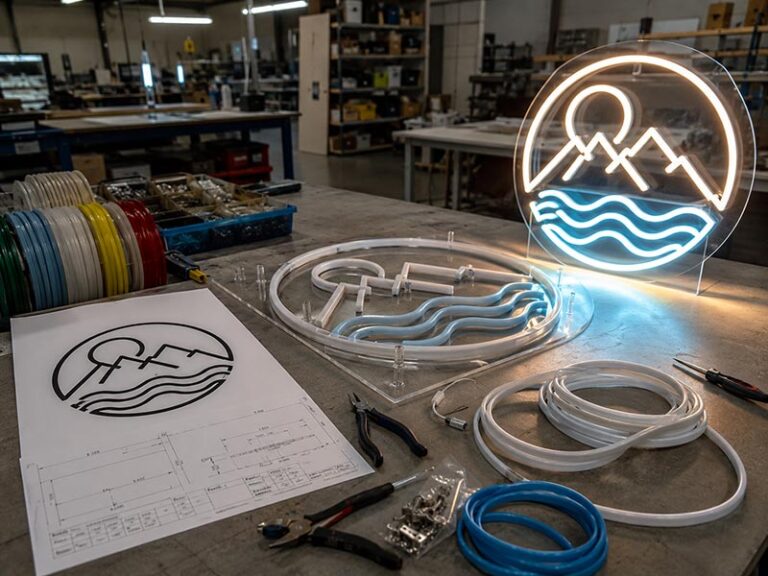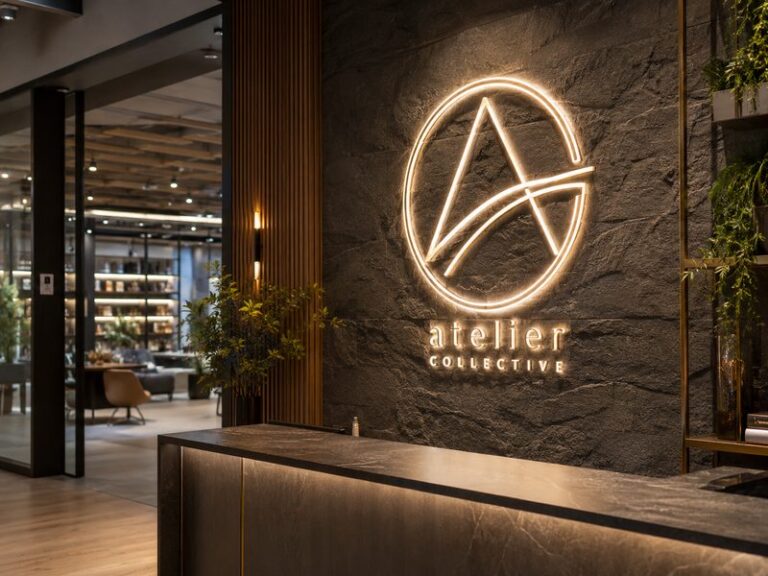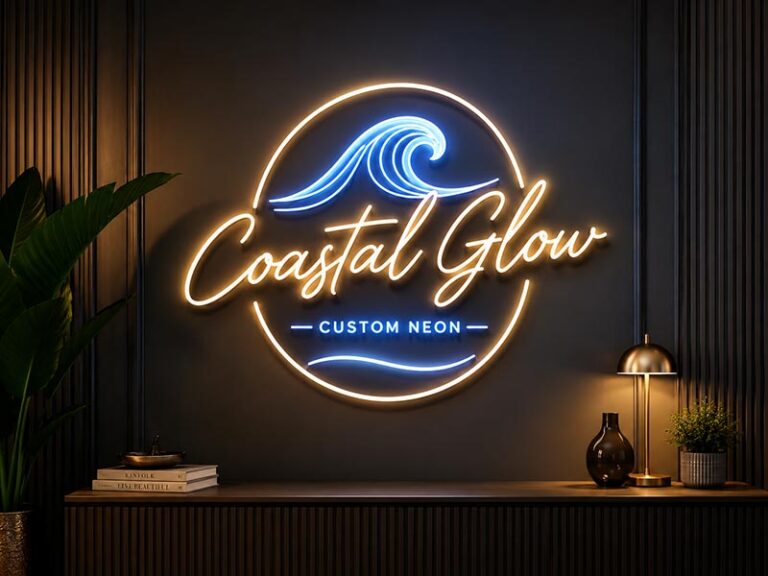

A frameless LED neon sign can look almost effortless once it is installed: illuminated letters appear to float directly on stone, timber, plaster, glass, or another architectural surface, while the broad sheet of acrylic normally associated with LED neon is barely visible or completely absent. The interesting part is that removing visible material does not remove the work that material used to perform. Every illuminated line still has to remain accurately positioned, every disconnected element still needs support, electrical connections still need somewhere to go, and the entire sign must survive production, packing, international transport, installation, and future maintenance.
Frameless LED neon signs are LED Neon Flex signs designed to minimise the visual presence of a conventional full-size backing panel. Depending on the design, the illuminated lines may use cut-to-shape acrylic, individual backing pieces, narrow transparent supports, concealed metal reinforcement, suspension hardware, or other fixing structures. The visual goal is a cleaner floating appearance, but the support, wiring, power, mounting, and service requirements still have to be engineered.
This distinction is easy to miss when looking at a front-view rendering. Imagine a seven-letter retail logo apparently floating on a textured wall. A designer can remove the acrylic background from a digital image in seconds, but a production engineer immediately sees a different set of questions: what holds each letter, how are all seven letters aligned, where do their wires enter the wall, how will the installer reproduce the approved spacing, and how will the pieces be protected in transit? Frameless neon becomes much easier to understand once it is viewed as an installation system rather than simply a style of light.
What Is a Frameless LED Neon Sign?

A frameless LED neon sign is an LED Neon Flex sign in which the conventional broad acrylic backing panel is reduced, reshaped, divided, concealed, or removed. “Frameless” describes the finished appearance rather than one standard construction. The Flex may still rely on individual acrylic pieces, narrow transparent supports, a concealed frame, or another engineered structure to maintain its shape and mounting position.
Frameless vs No Backboard
The words “frameless,” “no backboard,” “backing-free,” and “floating neon” are often used for similar-looking signs, but they do not always describe the same construction. A genuine no-large-backboard design may have no broad acrylic sheet behind the artwork, while another sign that looks almost identical from the front may use clear acrylic trimmed very close to the shape of each letter. Both can produce a light, floating appearance, yet their installation, transport, wiring, and maintenance requirements can be very different.
A useful way to define the product is to ask what physically holds the Neon Flex in its intended path. LED Neon Flex is flexible enough to follow curves, but it does not become a rigid finished logo by itself. iduoduo’s engineering documentation defines an LED neon sign as Neon Flex combined with an acrylic backing, metal frame, desktop base, or another supporting structure. That support remains an important part of the product even when it is deliberately hidden from normal viewing angles.
This is particularly important when evaluating supplier quotations. Two products described as “frameless” may not be technically equivalent. One may use individual acrylic backings behind every letter, while another uses a continuous hidden frame. A third may expect the wall itself and the local installer to provide much of the final alignment. Comparing the visible front alone can therefore hide meaningful differences in installation labour, packaging requirements, structural stability, and after-sales serviceability.
Common Frameless Structures
Frameless appearance can be achieved through several practical structures. Cut-to-shape backing follows the outside contour of the wording or logo instead of creating a broad rectangular panel. Hollow-out backing removes unnecessary areas while retaining connecting sections. Individual backing places separate acrylic pieces behind individual letters or graphic elements. Larger installations may introduce metal reinforcement, transparent support strips, suspension structures, or combinations of several methods when no single backing system can provide both the desired appearance and sufficient stability.
iduoduo’s LED neon engineering references include Full Board, Cut-to-Shape, Hollow-Out, Individual Letter Backing, and layered structures. Cut-to-shape acrylic provides a visually lighter result while retaining an integrated support path. Individual backing produces an even cleaner appearance because the wall remains open between letters, although it increases the amount of alignment, wiring, and installation work that must be controlled at the site.
| Structure | Typical Visible Support | Installation Complexity | Practical Application |
| Full acrylic board | Clearly visible | Low to medium | Portable signs, events, simple wall installation |
| Cut-to-shape acrylic | Low | Medium | Logo outlines, lettering, retail interiors |
| Hollow-out backing | Low | Medium | Larger designs needing reduced visual weight |
| Individual letter backing | Very low | High | Separate letters and premium brand walls |
| Narrow transparent support | Very low | High | Floating-effect installations |
| Concealed metal support | Low from front | High | Large or structurally reinforced signs |
The table shows that frameless construction is better understood as a range of solutions rather than one fixed product. Reducing the amount of visible material can improve the appearance, but it can also move more responsibility into the mounting system, wiring arrangement, site preparation, or installation template. The right solution is therefore the one that makes the structure visually quiet without making the sign unnecessarily difficult to manufacture or install.
Full Backing Differences
A full acrylic backing performs several functions at the same time. It holds Neon Flex in position, controls spacing, provides mounting holes, helps carry product weight, protects parts of the wiring, creates one integrated assembly, and gives the packaging team a rigid structure to protect. iduoduo’s LED neon engineering documentation specifically identifies these functions, which is why backing selection should be treated as a structural decision rather than simply an aesthetic option.
When a broad backing panel is removed, those functions do not disappear. Alignment may have to be transferred to an installation template. Each letter may require its own fixing points. Wiring can require several wall penetrations. Separate components may need individual protection during shipping. A concealed frame may be required where the acrylic panel previously helped maintain overall rigidity. This redistribution of functions is one of the main reasons a clean-looking frameless sign can actually require more engineering than a conventional panel-mounted design.
The visual benefit can still be substantial. A full rectangular acrylic panel may cover stone grain, timber texture, decorative plaster, tile, greenery, or another deliberately selected interior finish. A carefully developed frameless or cut-to-shape sign lets more of that surface remain visible, so the light feels integrated into the architecture instead of sitting on a separate transparent plaque. For many commercial interiors, that relationship between the light and the wall is the main reason to consider frameless construction.
How Does a Frameless LED Neon Sign Work?

A frameless LED neon sign works by transferring the functions of a large backing board to smaller supports, individual mounting points, hidden frames, electrical routes, templates, and the installation surface itself. The Neon Flex still requires controlled positioning, secure fixing, correctly sized power supplies, and planned wiring. The engineering goal is to keep these functional elements stable while making them visually unobtrusive.
Supporting the Neon Flex
Neon Flex is designed to bend, but its flexibility has practical limits. The illuminated path still needs to follow the approved artwork after manufacturing, transport, handling, and installation. Unsupported areas can twist or shift, while excessively tight curves can distort the silicone light surface or place stress on internal components. A good frameless structure therefore supports the line only where necessary while keeping the supporting material outside the main visual focus.
Common Flex references in iduoduo’s LED neon engineering documentation include approximately 6 × 12 mm, 8 × 16 mm, and 10 × 20 mm cross-sections, together with other specialised specifications. Smaller profiles can help with finer lettering and close-view details, whereas wider profiles tend to suit larger graphics and stronger visual presence. As profile width increases, the practical bending radius generally increases as well, which is particularly relevant when a compact logo contains sharp corners or tightly packed curves.
A small script logo may only need discreet cut-to-shape acrylic directly behind the light path. Separate block letters can use individual backing pieces. Larger signs may require a hidden aluminium or steel structure because narrow acrylic sections alone would not provide enough stiffness. The support system should therefore follow the scale and geometry of the artwork rather than a predetermined marketing category such as “completely frameless.”
This approach also makes maintenance more realistic. If support, wire connections, and fixing points are deliberately organised, a technician has a better chance of identifying and accessing a problem later. A structure designed only to look invisible in the first installation photograph may create unnecessary difficulties if a cable, controller, or section of Flex eventually requires inspection.
Power and Wire Routing
Wiring often determines whether a frameless sign still looks clean once it is installed. A full acrylic panel gives designers a relatively large hidden area behind which cables can travel. Separate letters or narrow backing pieces reduce that space, so every connection needs a planned route toward the power source. If these routes are considered only after manufacturing, the installer may be forced to run visible wires between letters or across a finished wall.
Possible solutions include individual wire exits directly behind letters, wall penetrations, channels concealed inside the architectural finish, routes behind support frames, raceways, or access through a ceiling void. The appropriate method depends on the wall construction and whether the project allows cables to pass behind the finished surface. iduoduo’s engineering notes specifically recognise that even clear-backed projects can struggle to make all wiring completely invisible, which is why cable paths and cable colours should be considered during product development.
LED neon commonly uses low-voltage DC systems. iduoduo’s current engineering references include 12V and 24V configurations, with the final choice depending on the Flex specification, total illuminated length, power consumption, controller arrangement, cable run, and expected voltage drop. Long or large installations may need several feed points rather than relying on one long electrical path, because excessive voltage drop can cause visible brightness differences toward the end of a run.
| Engineering Item | Common Project Reference | Main Design Effect |
| Neon Flex profile | 6 × 12, 8 × 16, 10 × 20 mm | Detail level, visual weight, bending behaviour |
| DC operating system | 12V or 24V | Circuit layout, voltage drop, power configuration |
| Acrylic backing where used | 4, 5, 6, 8, 10 mm | Weight, stiffness, flatness, mounting |
| White-light CCT | 2700–3000K, 3500–4000K, 6000–6500K | Atmosphere and perceived colour |
| Large designs | Often segmented or multi-fed | Shipping, installation, electrical stability |
These figures are useful project references rather than universal specifications. A manufacturer should confirm them against the actual artwork, dimensions, environment, and installation method. Selecting a Flex profile simply because it was used successfully on another sign can create problems if the new artwork has tighter bends, smaller internal spaces, or a very different viewing distance.
Large Frameless Signs
Scale changes almost every part of a frameless LED neon project. A 600 mm indoor logo may be easy to keep rigid with narrow acrylic supports, while a 4 m brand installation can experience significantly greater bending, twisting, packaging stress, and leverage at mounting points. Simply enlarging the original file without reconsidering structure, circuits, transportation, and site assembly can turn a visually simple concept into a difficult installation.
iduoduo’s large-neon engineering references include segmented backing, multiple power supplies, multiple wiring groups, metal reinforcement, installation numbering, separate packaging, and final site assembly where required. Aluminium frames, steel frames, back supports, cross bracing, and hanging frames can be used when additional rigidity is needed. These structures are intended to improve flatness and installation stability rather than to make the product unnecessarily heavy.
No-large-backboard construction also increases several practical demands. The line has fewer broad surfaces supporting it, so fixing becomes more important. Wiring can be more exposed. Packaging needs to protect more vulnerable individual areas. The installer has more responsibility for alignment. iduoduo’s documentation therefore treats large no-backboard neon as an engineering-review item rather than a standard cosmetic option.
Segmentation is often the sensible solution rather than a defect. Breaks can be positioned between words, between letters, or at natural changes in the artwork where the joint becomes difficult to notice from the normal viewing distance. A well-planned segmented system can reduce bending, carton size, handling difficulty, and international freight risk without changing the overall visual impression once the sign is assembled.
Which Designs Work Best Without a Full Backboard?

Designs with clear line paths, moderate curves, practical spacing, and logical fixing points usually work best without a full backing board. Continuous scripts and simple outlined logos are often easier to engineer than dense artwork containing many isolated components. Very tight corners, tiny enclosed spaces, closely spaced lines, and disconnected details should be reviewed before the final size and mounting system are approved.
Suitable Logo Geometry
The strongest frameless neon designs often have a visual structure that naturally supports a physical line structure. Continuous script lettering is a good example because several characters can share an uninterrupted path. Simple outline logos can behave in a similar way. Even individual block letters can work well when their geometry provides enough area for discreet supports and when the wall can accept the required mounting and wiring arrangement.
The engineering team looks at the artwork differently from the graphic designer. Digital lines have no physical thickness, but real Neon Flex does. A perfect sharp corner in an SVG file may need a small radius once it becomes silicone Flex. Two lines that appear comfortably separated on a screen can become too close after each is represented by an 8 mm or 10 mm physical light path. Negative spaces can also close visually after illumination spreads into the surrounding area.
LED neon is fundamentally well suited to linear graphics. iduoduo’s engineering documentation identifies line-based logos as strong candidates, while large solid areas, photographic effects, and complex filled graphics may be better developed with Acrylic LED Logo Signs, illuminated panels, printing, or combined constructions.
This does not mean a complex logo has to be rejected. It means the product type should follow the graphic character. A brand name can use neon while a solid emblem uses acrylic or printed material. A complex colour element can remain printed while an important outline is illuminated. Hybrid solutions often retain more brand detail than forcing every part of the artwork into a single neon technique.
Small and Complex Details
Small designs expose the limitations of physical materials more quickly than large ones. A complex logo may look perfectly readable at 400 mm wide on a laptop, yet leave too little physical space for Neon Flex, supports, wire connections, and internal gaps when manufactured at that same size. The difficulty is not simply whether the factory can bend the line once; the resulting sign also needs to remain stable, clean, repairable, and visually recognisable.
Very tight bends may distort the illuminated face or stress the internal flexible circuit. Closely spaced lines can visually merge after the sign is turned on. Small enclosed counters may become difficult to fabricate, clean, or support. Multiple line crossings create additional connection points and potential visible wiring. These are normal physical constraints rather than unusual defects in a particular factory.
iduoduo’s documented approaches for overly small or complex artwork include increasing the overall dimensions, simplifying selected details, merging certain line paths, combining printed graphics with neon, or changing the product to an Acrylic LED Logo Sign when that technology represents the design more accurately.
A responsible simplification should preserve identity rather than randomly remove details. A small dot that is central to the brand symbol may deserve more attention than a decorative internal line. A distinctive curve may have to remain while several secondary intersections are merged. This is where experienced manufacturing review adds value: the aim is to preserve what makes the logo recognisable while adapting details that have little visual importance at the actual installation distance.
Separate Letters
Separate letters can create one of the most convincing frameless effects because the wall remains completely open between characters. They also transfer much more responsibility to the installer. With a full acrylic panel, the relative positions of the letters are fixed before the sign leaves the factory. With seven individual elements, the site team may need to recreate the baseline, spacing, height, orientation, mounting holes, and cable positions for seven separate assemblies.
Small errors can accumulate. A single letter that is 3 mm high may not look serious on its own, but inconsistent positioning across a long word can become obvious when viewed from the opposite side of a lobby or shop. Templates and dimensioned installation layouts therefore become increasingly important as the number of individual elements increases.
The wall itself may complicate the arrangement. Stone joints, timber slats, tiles, metal cladding seams, or concealed structural members can interfere with an otherwise logical hole position. For this reason, wall photographs and wall material information should ideally be available before the final backing and hole layout are approved.
When the installation becomes unnecessarily complicated, individual or cut-to-shape transparent backing can provide a useful middle ground. The acrylic can connect enough parts to preserve alignment while remaining difficult to notice from the normal viewing position. The most successful project is not necessarily the one that removes the most material; it is the one that achieves the desired appearance without turning every installation step into a custom site problem.
What Are the Benefits and Trade-Offs?

Frameless LED neon offers a cleaner appearance and allows more of the architectural background to remain visible, but the visual gain is usually accompanied by more demanding alignment, wiring, packing, and installation. It is therefore not automatically better than full backing. It is most valuable when preserving the wall finish or creating a floating effect is important enough to justify the additional engineering and site preparation.
Visual Benefits
A conventional clear acrylic board can already be visually light, but it is still a physical surface. Under certain lighting conditions it may reflect windows, spotlights, cameras, or surrounding objects. Its edges can also become noticeable when people approach the sign closely. Reducing the backing area changes the way the illuminated artwork relates to the interior because the background material remains more visible around and between the neon lines.
This can work especially well on stone, timber, textured plaster, decorative tiles, greenery, or other surfaces selected as part of a commercial interior concept. A warm-white script directly associated with a textured stone wall creates a different impression from the same script mounted on a large rectangular transparent sheet. The result often feels more architectural and less like a separate decorative object attached after the interior was completed.
Frameless arrangements can also photograph more cleanly because there is less broad acrylic surface available to catch reflections. This can be useful in restaurants, hotels, retail spaces, beauty businesses, events, and brand walls where customers frequently take photographs or video near the sign.
The term “frameless” should still be used realistically. A side view may reveal narrow acrylic, connectors, brackets, or cables that disappear from the main frontal viewing angle. A practical design target is therefore to minimise visual interference from the normal viewing position rather than claiming that every functional component will be invisible from every angle.
Installation and Maintenance
The most important trade-off is that some work previously performed by the backing panel moves into the installation process. A single full board arrives with all letters already positioned relative to each other. Individual backing or no-large-backboard construction requires more on-site layout, more individual fixing points, and often more wire planning. This can increase local labour even if the factory material cost is lower.
The difference becomes particularly important in multi-location programmes. An additional 20 or 30 minutes of local work may not matter much for one store, but repeated across 50 or 100 stores it becomes a meaningful part of the rollout cost. Templates, numbered components, consistent cable exits, repeatable hardware, and stored production files can therefore provide more commercial value than reducing a small amount of acrylic from each sign.
Maintenance should also be considered before the wall is closed. If all cable joints disappear into inaccessible cavities, the first installation may look excellent but future fault diagnosis can become difficult. A good frameless system balances visual concealment with practical access to power supplies, controllers, and important connection points.
Wall construction can completely change this balance. A prepared timber feature wall with rear service access provides much more freedom than a finished solid-stone surface that cannot easily be drilled or opened. The correct backing choice should therefore be made together with installation conditions rather than selected independently from a catalogue photograph.
Shipping and Outdoor Use
Using less acrylic does not automatically make shipping easier. A full panel can be large and bulky, but it also keeps several illuminated sections tied together in one rigid assembly. Individual letters or narrow support structures may create more exposed edges, flexible sections, connectors, or isolated components that require additional foam separation, labelling, internal supports, and careful carton arrangement.
Outdoor projects require even more attention because a waterproof Flex alone does not make the whole sign waterproof. The complete system includes the Neon Flex, electrical connections, cable exits, power supply, controllers, mounting holes, support materials, fasteners, seals, and the way the local installer closes wall penetrations. Water often finds weaknesses at connections and interfaces rather than through the main silicone body.
iduoduo’s current engineering references describe regular outdoor LED neon projects around an IP65 approach, higher-rain or higher-humidity projects around IP67, and IP68 configurations on request. The same documentation makes clear that final performance still depends on site installation and electrical sealing, so an IP rating should not be treated as permission to ignore mounting and cable-entry details.
Coastal and high-humidity conditions introduce additional concerns, including fastener corrosion, salt exposure, condensation, power-supply positioning, and periodic maintenance. A frameless outdoor sign should therefore be designed around its environment first. Appearance matters, but exposure, drainage, service access, and fixing reliability determine whether that appearance remains attractive after months or years of real use.
How Are Frameless LED Neon Signs Installed?

Frameless LED neon signs can use individual wall fixings, narrow backing pieces, concealed frames, suspension systems, or other project-specific supports. Because there is no large panel controlling every component’s position, accurate templates and planned wire exits become especially valuable. The mounting method should always match the wall material, product weight, cable route, installation height, and future maintenance requirements.
Mounting Methods
There is no universal frameless mounting method because wall conditions vary considerably. Concrete, brick, plasterboard, timber, glass, stone, tiles, and aluminium composite panels all behave differently when drilled or loaded. The mounting system should therefore be selected only after the installer or project team provides reliable information about the actual substrate.
Permanent commercial installations often use mechanical fixing when the sign size and weight justify it. Smaller or temporary products may use hanging systems, steel cables, or specialised supports depending on the application. iduoduo’s LED neon installation documentation covers screw mounting, hanging chains, steel cables, and desktop support structures, with fixing decisions related to weight, balance, installation surface, and product use.
Factory-supplied hardware should not automatically be assumed suitable for every wall. An anchor intended for solid concrete may be inappropriate for hollow plasterboard. Stone may require specialised drilling. Glass can impose restrictions on drilling entirely. The product design can prepare the fixing interface, but the final anchor selection may still belong to the local installation team that can inspect the actual site.
Adhesives deserve similar caution. Lightweight indoor components on smooth, clean surfaces are very different from large signs exposed to heat, moisture, repeated handling, or vibration. For permanent commercial use, mechanical fixing or a properly engineered combined fixing method is generally easier to evaluate than relying on a generic adhesive assumption.
Templates and Alignment
A full-size installation template is one of the most useful tools for separate-letter frameless neon. Instead of asking the installer to judge spacing from a photograph, the template transfers the approved design directly onto the wall. The site team can position the template, verify the overall width, height, baseline, and relationship to nearby architectural features, and then mark holes and cable exits before any finished component is installed.
Templates become particularly valuable when the logo contains many disconnected parts. A dot above a letter, a small icon beside a word, or separate characters can easily drift from their intended position when mounted individually. Accurate layouts reduce that risk and help keep the installed result consistent with the artwork that was approved before production.
Large segmented signs need another layer of organisation. iduoduo’s engineering references recommend placing divisions between letters, at natural graphic breaks, or in less visible areas where connectors can be concealed. Sections should be numbered and supported by an installation layout so that the local team understands their correct sequence.
This system is especially valuable for repeated commercial projects. If 40 stores all rely on installers visually estimating spacing, the brand appearance will gradually vary. A standard template, stable component numbering, and consistent installation drawings make the manufacturing file part of the brand standard instead of leaving the final visual result entirely to local interpretation.
Wiring and Site Preparation
The easiest time to hide wiring is before the wall is finished. If the project allows rear access, electrical entries can often be positioned directly behind individual letters or graphic elements, keeping the visible front area clean. Where rear access is unavailable, the wire path may need to lead toward a raceway, concealed channel, frame, ceiling void, or another serviceable location.
The electrical arrangement should be developed together with the mounting layout. Large designs may require several feeds to manage voltage drop. RGB and RGBW products introduce controllers and additional conductors. Power supplies need enough capacity for the connected load and should not be trapped in sealed high-temperature spaces where heat cannot dissipate normally.
A useful site check should confirm practical conditions before production begins:
- Wall material and wall finish
- Available installation width and height
- Final mounting height
- Power location
- Available cable route
- Access behind the wall
- Indoor or outdoor environment
- Moisture and weather exposure
- Drilling or fixing restrictions
- Power-supply position
- Maintenance access
- Required installation deadline
Mirror and glass surfaces deserve particular attention because they can expose details that a solid wall hides. A mirror may reflect the back of the sign, cables, fixings, and support pieces. Glass installations raise questions about both front and rear appearance, weight, reflections, hanging points, and whether drilling is allowed. iduoduo’s engineering guidance specifically highlights these issues for mirror and glass applications.
The cleaner the desired result, the more important this early site information becomes. A factory can develop a precise neon assembly, but it cannot make a power cable disappear through a finished stone wall if no route was allowed for it before the sign arrived.
How Do You Choose the Right Frameless Structure?

The right frameless structure balances appearance with manufacturability, installation labour, wall conditions, wiring, transport, and future maintenance. True no-large-backboard construction suits projects where the wall can accept precise individual fixing and hidden wiring. Cut-to-shape or individual transparent backing is often more practical when a similar floating appearance is needed with easier alignment, packing, and installation.
Match the Structure to the Space
The same logo can require completely different structures depending on where it will be used. A reception logo viewed at close distance puts a high priority on neat edges, concealed wiring, and discreet mounting. A nightclub installation may place more emphasis on brightness, colour control, and dynamic lighting. A retail-window sign may need the rear construction to look acceptable because people can see both sides through the glass.
Event products have another set of priorities. A sign that is installed for one evening and then transported to another venue may benefit from a more integrated backing or frame because rapid installation and repeated packing matter more than making every support disappear. A permanent luxury retail sign can justify more site preparation because the installation will remain in place and the surrounding materials are part of the visual concept.
| Project Condition | Usually More Practical Structure |
| Fast, simple installation | Full or cut-to-shape backing |
| Premium interior brand wall | Individual or narrow backing |
| Decorative wall must stay visible | Cut-to-shape or frameless structure |
| Multiple separated letters | Individual backing with full-size template |
| Large-format installation | Reinforced or segmented structure |
| Frequent relocation | Integrated backing or support frame |
| Wiring cannot enter the wall | Backing or concealed raceway solution |
| Complex outdoor exposure | Engineered support with weather protection |
These examples are not rigid rules. A large frameless installation can perform very well when the site has been prepared for it, while a small sign may still benefit from full backing if it needs to move frequently. The useful question is not which structure appears most minimal in a studio photograph, but which one will still look clean after real installation, real wiring, and real maintenance requirements are included.
Provide the Right Project Information
A vector logo is an important starting point, but it does not contain enough information to select a complete frameless structure. A manufacturer also needs to understand the final size, number of units, wall condition, indoor or outdoor environment, destination market, lighting colour, power position, mounting preference, and whether wires can enter the wall behind the artwork.
For multi-store projects, the information should go further. Wall widths may vary between locations. Some stores may use stone while others use plasterboard. Local electrical requirements may differ between countries. A common visual standard may therefore require more than one mounting or power configuration even when the logo appearance remains consistent.
Colour specification also deserves physical consideration. iduoduo’s white-light engineering references include approximately 2700–3000K for warmer light, 3500–4000K for a more neutral appearance, and 6000–6500K for cooler white. A warm-white neon line on cream plaster can feel very different from cool white on black stone, even when both designs use the same logo.
Providing these details early usually makes the purchasing process simpler rather than more complicated. It allows the initial structure and quotation to reflect the real project instead of pricing an attractive front-view rendering and then changing the cost later when the installer explains that the wall cannot be drilled or that power is located several metres away.
Review Manufacturability First
A useful manufacturability review looks at the sign as one system. The engineer considers line continuity, Flex profile, minimum bend behaviour, line spacing, support points, electrical feeds, wire exits, power supplies, mounting positions, segmentation, packing, transport, and maintenance access. A small design adjustment can sometimes improve several of these areas at the same time.
For example, increasing a logo by 10–15% may create enough room to produce difficult curves more cleanly. A narrow transparent bridge between two disconnected sections may be almost invisible from normal viewing distance but significantly improve handling. Moving a wire exit a few centimetres can prevent an exposed cable from running across decorative stone. Changing one excessively small detail from neon to printed acrylic can keep the logo recognisable while making the overall product more reliable.
iduoduo’s documented LED neon manufacturing process includes line-path engineering, Neon Flex selection, backing design, colour and control configuration, power matching, wire-exit planning, mounting preparation, lighting inspection, pre-shipment testing, export packaging, and repeat-production file management.
This review becomes particularly important before a repeated rollout. An unresolved issue in one prototype may seem minor, but the same mounting difficulty repeated across dozens of stores can become expensive. Solving structural, wiring, and installation questions in the first approved unit is usually far more valuable than finding a workaround at every installation site later.
Approve More Than the Front View
A front-view rendering confirms the appearance but does not fully define a frameless LED neon product. Before production begins, the approval should ideally cover overall dimensions, Flex specification, support or backing structure, light colour, controller type, wire exits, power requirements, mounting positions, segmentation, installation accessories, and packing method. For individual-letter projects, the rear construction and installation drawing can be just as important as the illuminated front view.
The production schedule should also be considered together with design complexity. iduoduo’s current LED neon references list a minimum order from one piece, approximately 5–7 days for a regular sample, approximately 7–15 days for special projects, around 7–10 days for standard small-batch production, and around 10–20 days for medium or more complex production. Actual timing depends on size, backing, Flex specification, controls, packaging, quantity, and approval progress.
Lighting products also follow a documented 72-hour pre-shipment testing process together with a three-year warranty reference. These figures are useful evidence of the production process, but they should not replace proper structural approval. Producing a sample quickly has little value if the sign reaches the site and the installer discovers that the cable exits, mounting pattern, or support structure do not match the wall.
Frameless LED neon works best when visual simplicity is the result of detailed planning rather than the absence of engineering. A sign can appear to float naturally on a wall only because the support, power, wiring, alignment, packaging, and mounting systems have already been resolved behind the scenes. For commercial projects, the most suitable structure is rarely the one that removes the greatest amount of material; it is the one that preserves the clean intended appearance while remaining practical to manufacture, transport, install, service, and reproduce.
Frequently Asked Questions
Is a frameless LED neon sign completely free of acrylic?
Not necessarily. “Frameless” is widely used to describe the visual appearance rather than one fixed technical structure. Some signs use no broad acrylic panel, while others use cut-to-shape clear acrylic, individual backing pieces, narrow transparent bridges, or a concealed frame. From normal viewing distance these supports can be difficult to notice. The correct way to evaluate the product is to identify what physically supports the Neon Flex and whether that support matches the installation and transport requirements.
Are frameless LED neon signs harder to install?
They can be harder to install when the artwork contains several separate letters or graphic elements. A full backing panel keeps the logo aligned before it reaches the site, whereas individual elements must be positioned accurately by the installer. Full-size templates, numbered parts, prepared fixing points, and planned cable exits can reduce this difficulty considerably. Installation complexity also depends on the wall material, access behind the wall, sign size, mounting height, and whether wiring needs to be completely concealed.
Which logos are most suitable for frameless LED neon?
Simple linear logos, continuous scripts, open outlines, and lettering with adequate spacing are generally the easiest to develop. Designs containing very small counters, sharp corners, dense parallel lines, many isolated details, or large solid areas require more review. Some complex logos can be made more practical by increasing the overall dimensions, simplifying secondary details, or combining neon with printed or acrylic elements. The goal should be to preserve brand recognition while adapting the artwork to the physical limits of Neon Flex.
Can frameless LED neon signs be used outdoors?
Yes, but outdoor suitability depends on the complete sign system rather than only the Neon Flex. Waterproof connections, cable exits, power supplies, mounting hardware, sealing, drainage, corrosion resistance, and local installation all affect performance. iduoduo’s current project references include IP65 arrangements for regular outdoor conditions, IP67 options for higher-rain or higher-humidity applications, and IP68 configurations on request. Final requirements should be confirmed from the actual installation environment instead of assuming every frameless sign uses the same outdoor specification.
How can wires be hidden on a frameless neon sign?
The cleanest solution is usually to plan wire exits before production and, where possible, position them behind individual letters or graphic elements so cables can pass through the wall. Other projects may route wiring through a concealed frame, raceway, channel, ceiling space, or architectural cavity. Transparent backing does not automatically make wires invisible, especially on light-coloured or reflective surfaces. Wall photographs, available power locations, and rear-access information should therefore be supplied before the final construction is approved.
Is cut-to-shape acrylic better than a true no-backboard design?
Neither structure is universally better. Cut-to-shape acrylic usually gives a cleaner appearance than a full rectangular panel while keeping more of the sign together as one assembly, which can simplify alignment, packing, and installation. A true no-large-backboard design can create an even lighter architectural appearance, but separate elements often require more mounting points, wiring, and site preparation. For many commercial projects, cut-to-shape or individual transparent backing offers a useful balance between floating appearance and practical installation.
What information is needed to quote a frameless LED neon project?
A useful quotation normally starts with the vector logo or artwork, target width and height, quantity, indoor or outdoor use, wall photograph, wall material, destination country, preferred neon colour or colour temperature, mounting preference, and available power position. For larger or repeated projects, installation height, multiple store dimensions, wire-routing restrictions, control requirements, packaging needs, and delivery dates should also be included. The more accurately the site conditions are understood, the less the quotation has to rely on assumptions that may change later.