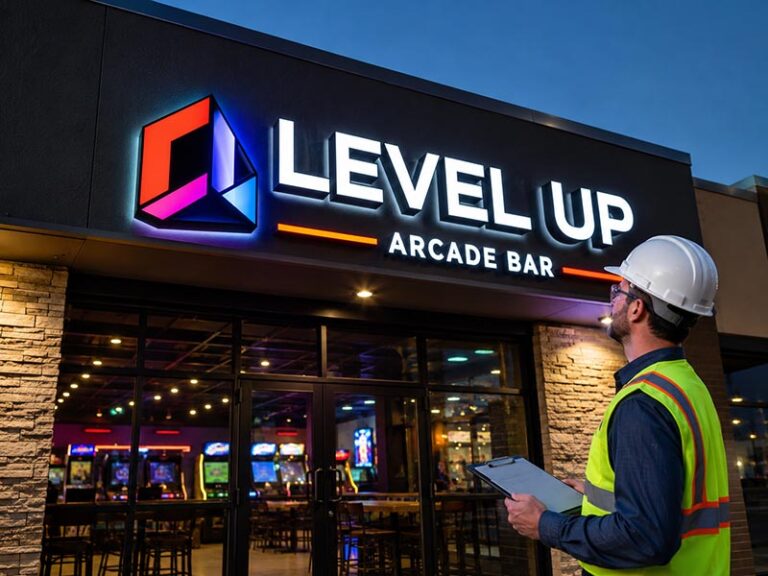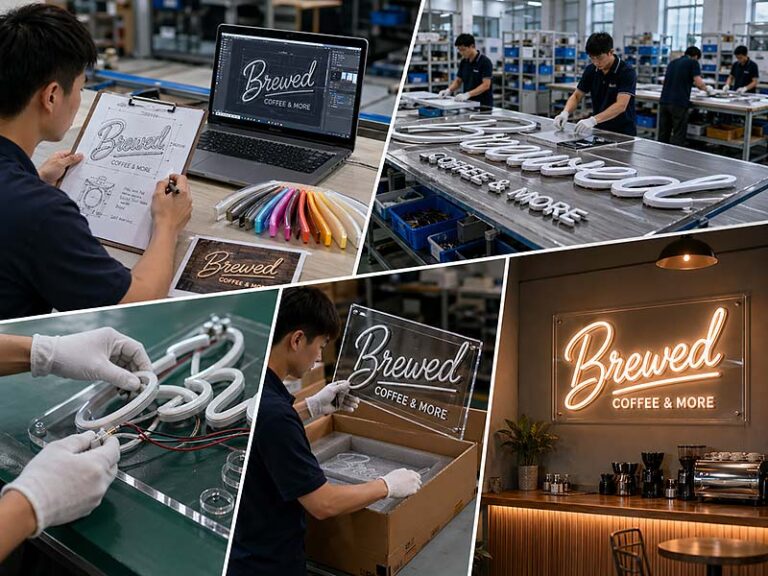
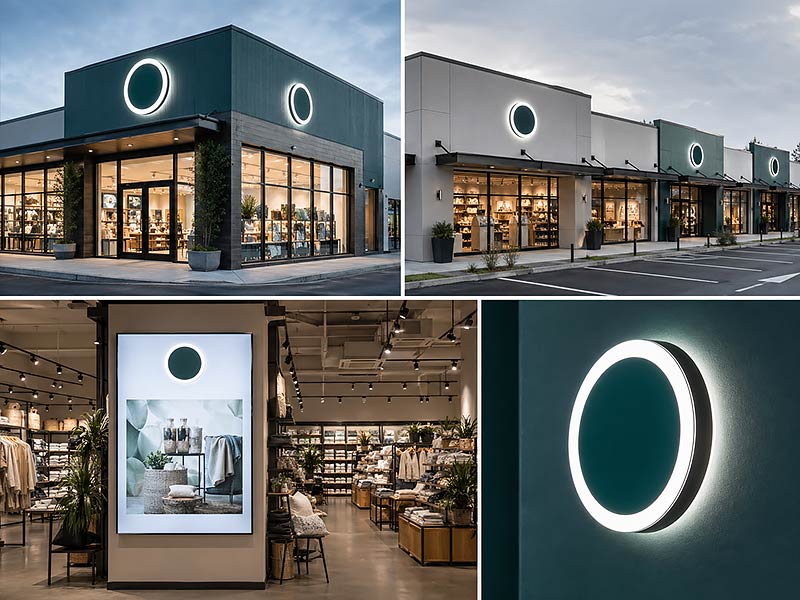
A custom LED neon sign can make a storefront easier to notice, turn a blank wall into a photo spot, and help a brand feel more memorable. But a good sign is not only about choosing a nice color or approving a beautiful mockup. The real result depends on details such as LED strip quality, neon tube finish, acrylic backing, wire position, adapter safety, waterproof level, packaging, and installation method.
A good custom LED neon sign buying guide helps you compare design, material, brightness, waterproof rating, supplier ability, production time, packing quality, shipping method, and installation details before placing an order. The right sign should match the space, brand style, use environment, budget, and long-term maintenance plan—not just look good in a supplier photo.
Many problems happen because small details are confirmed too late. A logo line may be too thin for LED neon tubing. A sign may look bright in a dark factory video but feel harsh inside a small café. A wire may exit from the wrong side and make the final wall look messy. This guide helps you check those details before production starts, so the sign arrives ready for real commercial use.
What Is a Custom LED Neon Sign?
A custom LED neon sign is a made-to-order illuminated sign made with flexible LED neon tubing, usually mounted on acrylic, metal, or another backing material. It can be shaped into logos, words, icons, slogans, arrows, decorative graphics, and brand displays. Compared with traditional glass neon, LED neon is usually lighter, safer, easier to ship, and more practical for commercial customization.
LED Neon vs Glass Neon
Traditional glass neon has a classic look. It is often used in retro bars, vintage storefronts, old theaters, and specialty interiors. The glow is unique, but the structure is fragile. Glass tubes can break during transportation, installation, or daily use. For international projects, that risk becomes more serious because repair and replacement are harder.
LED neon signs use flexible silicone or PVC neon tubing with LED strips inside. They create a neon-style glow, but the product structure is usually more suitable for modern commercial spaces, export shipping, and repeat production.
| Comparison Point | LED Neon Sign | Traditional Glass Neon |
|---|---|---|
| Main structure | Flexible LED neon tube | Bent glass tube |
| Breakage risk | Lower | Higher |
| Shipping safety | Easier to pack and ship | More fragile |
| Voltage | Usually low-voltage system | Often high-voltage system |
| Weight | Lighter | Heavier |
| Custom shapes | Flexible for text, logos, and icons | Requires skilled glass bending |
| Maintenance | Easier for commercial use | Often needs specialist repair |
| Best use | Retail, restaurants, events, offices, chain stores | Retro bars, vintage spaces, specialty signs |
This does not mean glass neon has no value. Some projects still need the exact look of real glass neon. But for most commercial projects, LED neon is easier to produce, safer to ship, simpler to install, and more flexible for future repeat orders.
Common Materials
A custom LED neon sign is not only the glowing tube. It is a full product system. The final quality depends on how the tube, backing, power supply, wiring, controller, mounting parts, and packaging work together.
Common parts include:
| Part | Common Options | Why It Matters |
|---|---|---|
| Neon tube | Silicone neon flex, PVC neon flex | Affects brightness, bending, durability, and surface finish |
| LED strip | Single color, RGB, RGBW | Affects color, brightness, and control options |
| Backing board | Clear acrylic, colored acrylic, metal, PVC board | Affects strength, weight, appearance, and installation |
| Power supply | 12V or 24V adapter | Affects stable lighting and safety |
| Control parts | Dimmer, remote, RGB controller | Affects brightness and color control |
| Mounting parts | Screws, spacers, hooks, chains, brackets | Affects installation speed and final look |
| Packaging | Foam, carton, wooden crate | Affects shipping safety |
For indoor signs, clear acrylic backing is common because it looks clean and modern. For outdoor or semi-outdoor signs, the factory needs to consider waterproofing, sealed wiring, UV exposure, stronger mounting, and protected power connection.
For event signs, lightweight backing and reusable packaging may matter more. A wedding or exhibition sign may be installed, removed, packed, and reused many times. In that case, the sign should not only look good once; it should survive repeated handling.
Custom Options
Good customization should go beyond size and color. A professional manufacturer should help turn your idea into a sign that can be produced, shipped, installed, and used safely.
Common custom options include:
- Logo, text, icon, slogan, or graphic shape
- English, Chinese, or bilingual text
- Fixed LED color or RGB color-changing effect
- Warm white, cool white, red, pink, blue, green, yellow, or brand color
- Clear acrylic, black acrylic, colored acrylic, or cut-to-shape backing
- Indoor, semi-outdoor, or outdoor structure
- Wall-mounted, hanging, freestanding, or embedded installation
- Dimmer, remote control, timer, or RGB controller
- US, UK, EU, AU, or other plug standards
- OEM label, custom packaging, or neutral packaging
- Bulk specifications for sign companies, resellers, event planners, or chain-store teams
The important point is not whether the factory can “make anything.” The real question is whether the design can be made cleanly and used reliably. Very thin fonts, tiny logo details, sharp corners, and complex gradients may need adjustment before production.
For repeat orders, store rollouts, and reseller projects, repeatability is especially important. Once a sample is approved, the factory should save the artwork, size, LED color, tube type, backing material, adapter type, packaging method, and installation details.
Commercial Safety
LED neon signs are widely used in commercial spaces because they are usually low-voltage, lightweight, and safer than fragile glass neon. This makes them suitable for restaurants, cafés, salons, gyms, offices, retail stores, exhibitions, weddings, and event backdrops.
However, “LED” does not automatically mean the product is safe. Safety depends on the full system.
Before ordering, check:
- Is the power adapter suitable for the destination country?
- Is the sign for indoor or outdoor use?
- Is the wiring clean and protected?
- Is the brightness suitable for the space?
- Is the backing strong enough for the sign size?
- Are the mounting parts suitable for the wall?
- Will a local electrician be needed?
- Is the adapter protected from moisture?
- Are dimmers, remotes, or controllers matched correctly?
A sign for an office reception wall may need soft brightness and hidden wiring. A bar window sign may need stronger brightness and a simple plug-in setup. An outdoor storefront sign may need stronger waterproofing and professional installation. The same product structure should not be used for every scene.
When LED Neon Is the Right Choice
LED neon is usually a good choice when the project needs visual impact, custom shape, lighter weight, easier installation, and safer shipping. It works especially well for interior brand walls, photo zones, promotional displays, event backdrops, small storefront signs, and decorative commercial spaces.
LED neon is especially suitable for:
| Project Need | Why LED Neon Works Well |
|---|---|
| Custom logo display | Flexible tube can follow logo shapes |
| Photo wall | Soft glow creates strong social media effect |
| Store atmosphere | Adds mood without heavy construction |
| Event decoration | Lightweight and easier to install |
| Office reception | Clean logo effect with controlled brightness |
| Reseller projects | Easy to customize for different clients |
| Chain-store interiors | Repeatable design and color control |
LED neon may not always be the best choice for every outdoor storefront. If the sign needs strong long-distance visibility, large 3D depth, or a more architectural look, channel letters or light boxes may be better. A reliable manufacturer should explain these differences instead of pushing the same product for every project.
Which LED Neon Sign Fits Your Project?
The right LED neon sign depends on where it will be used, how far people will see it from, whether it needs to attract foot traffic, create atmosphere, help photography, or support brand consistency. A small café quote sign, a large storefront logo, an event backdrop, and a chain-store sign package should be planned differently.
Restaurants and Bars
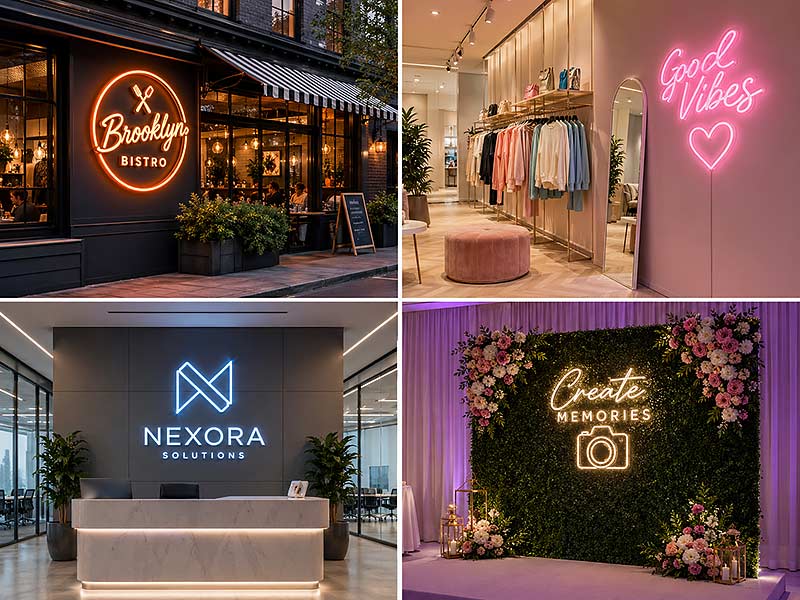
Restaurants, cafés, bars, and entertainment venues usually buy LED neon signs for three reasons: visibility, atmosphere, and social sharing.
A restaurant storefront sign should be readable quickly. People may see it while walking, driving, or looking across the street. A simple logo, bold shop name, or bright “Open” sign near the window can help increase attention.
Inside the space, the goal is often different. A café may need a warm coffee cup icon or a short phrase behind the counter. A cocktail bar may want a glowing glass shape, brand slogan, or photo-wall sign. A themed restaurant may need multiple signs for different zones.
Good sign ideas for restaurants and bars include:
- Brand logo neon sign near the entrance
- “Open”, “Welcome”, or “Happy Hour” window sign
- Coffee cup, beer glass, cocktail, heart, star, or food icon
- Photo-wall slogan such as “But First, Coffee” or “Cheers”
- Dining room, bar area, private room, or restroom direction sign
- Low-brightness mood sign for private rooms
- RGB neon sign for nightlife or themed events
- Seasonal signs for Christmas, Valentine’s Day, Halloween, or promotions
For script murder rooms, escape rooms, karaoke venues, and entertainment spaces, brightness control is very important. The sign should support the atmosphere, not destroy it. A dimmer or RGB controller can help create different moods.
Retail and Service Stores
Retail stores and service businesses use LED neon signs to guide attention and improve the visual experience. The sign should help people notice key areas, not just fill an empty wall.
For a salon, the sign may sit near a mirror, reception desk, or photo corner. For a boutique, it may highlight a fitting room, display wall, or cashier area. For a gym, it may create energy near the workout zone. For a barber shop, the sign may show personality from the storefront window.
Useful retail and service sign ideas include:
| Business Type | Good Sign Ideas |
|---|---|
| Hair salon | Brand logo, mirror frame neon, “New Hair Who Dis” |
| Nail salon | “Nail It”, service menu, soft pink wall sign |
| Gym | “No Pain No Gain”, “Cardio Zone”, motivational wall sign |
| Boutique | Fitting room sign, brand logo, product display lighting |
| Barber shop | Window sign, bold brand name, service slogan |
| Beauty studio | Reception sign, photo-wall phrase, soft decorative neon |
For these spaces, the best sign is usually not the most complicated one. It should match the store style, wall size, lighting, and customer behavior.
A practical rule: if people will take photos near the sign, avoid overly harsh brightness. If people must read the sign from outside, use stronger contrast and simpler wording.
Events and Exhibitions
Event signs need to look good, install fast, and survive repeated movement. A wedding sign, trade show booth sign, party sign, and brand event sign may only be used for a short period, but they still need professional appearance.
Popular event sign types include:
- “Mr & Mrs” wedding neon sign
- “Just Married” or custom name sign
- Exhibition booth logo sign
- Product highlight neon phrase
- Photo booth backdrop sign
- Large party theme sign
- RGB remote-control sign
- Marquee letters for retro event decoration
- Portable hanging sign for temporary venues
For event planners, reusability matters. A sign that can be used for multiple weddings or exhibitions has more value than a delicate sign that looks good only once.
| Event Need | Recommended Feature |
|---|---|
| Fast setup | Lightweight backing, hanging holes, chains |
| Reuse | Strong acrylic, protective packaging |
| Photo effect | Dimmable brightness, clean wiring |
| Brand display | Accurate logo shape and color |
| Theme flexibility | RGB or remote control |
| Large venue | Bigger size and high contrast |
If the sign will be moved often, ask the factory to strengthen the backing and provide better packaging. The packaging should not be treated as disposable if the sign will be reused.
Offices and Corporate Spaces
Office LED neon signs should feel more controlled and professional. The goal is usually brand image, not loud decoration.
A company may use a logo sign behind the reception desk, a slogan on a culture wall, or small directional signs inside the office. The lighting should match the interior design. Bright pink or strong RGB may work for a creative studio, but a law firm, finance office, corporate showroom, or B2B reception area may prefer warm white, cool white, or soft brand-color lighting.
Good office sign ideas include:
- Reception wall logo sign
- Company name and slogan sign
- Culture wall neon text
- Conference room direction sign
- Pantry, lounge, or HR room sign
- Soft decorative sign in break areas
- Brand history wall display
For office projects, wire planning is important. Visible messy cables can make a premium sign look cheap. Hidden wiring, clean acrylic edges, stand-off screws, and controlled brightness usually create a better result.
Chain Stores
Chain-store signs are not only about design. They are about consistency.
Producing one beautiful sign is much easier than producing the same sign for many locations. Chain stores need the same logo size ratio, LED color, backing shape, plug type, wire position, mounting method, and packaging standard.
A chain-store sign package should define:
| Standard Item | Why It Matters |
|---|---|
| Logo size ratio | Keeps brand identity consistent |
| LED color | Avoids different tones between stores |
| Backing shape | Keeps the same visual style |
| Power adapter | Makes replacement easier |
| Wire exit | Helps installation teams work faster |
| Installation template | Keeps placement consistent |
| Packaging method | Reduces shipping damage |
| Production records | Makes repeat orders easier |
For chain brands, the factory should keep approved project records. If the second batch looks different from the first batch, the brand image suffers.
For this type of project, a factory with OEM/ODM support, low MOQ sampling, design assistance, and repeat-order records can reduce a lot of communication work over time.
Sign Companies and Resellers
Sign companies, advertising shops, and resellers often need a different kind of support. They may not need only one sign for their own store. They need a factory that can handle different client designs, fast quotation, custom production, safe packaging, and repeat orders.
Common needs include:
- Custom logo neon signs for local clients
- Front-lit, backlit, or dual-lit channel letters
- LED neon and light box combinations
- Wedding, event, or retail display signs
- Outdoor or semi-outdoor versions
- Neutral packaging or private-label support
- Low MOQ for different custom projects
- Fast sample support
- Stable communication and production records
For these clients, the factory’s response speed and record-keeping ability are very important. If every reorder requires explaining the same details again, the process becomes slow and frustrating.
A good manufacturing partner should keep approved drawings, color notes, material choices, size records, wire positions, and packaging preferences. This makes future repeat orders easier and more accurate.
Interior Design and Renovation Projects
Interior designers and renovation companies often use LED neon signs as part of a larger space plan. In this case, the sign should not feel like a random decoration added at the end. It should match the wall material, lighting plan, furniture, brand style, and customer path.
Common applications include:
| Space Area | LED Neon Sign Use |
|---|---|
| Reception wall | Logo or brand slogan |
| Dining area | Mood phrase or icon |
| Corridor | Direction sign or decorative line |
| Photo zone | Social media wall sign |
| Product display | Highlight sign or brand message |
| Ceiling or cabinet area | Embedded neon line |
| Meeting room | Room name or small brand detail |
For design projects, wire position and installation method should be confirmed early. If the wall is already finished, hiding cables becomes harder. If the sign needs to be embedded into cabinets or wall panels, the factory should receive drawings or installation photos before production.
Quick Project Match Table
A simple project match table can help you decide which LED neon sign style is more suitable.
| Project Type | Main Goal | Better Sign Choice |
|---|---|---|
| Café | Warm atmosphere and photo spot | Warm white or soft-color neon slogan |
| Bar | Night visibility and strong mood | Bright color or RGB neon |
| Restaurant | Brand recognition and entrance attention | Logo sign, window sign, or menu highlight |
| Salon | Beauty atmosphere and social sharing | Soft pink, white, or brand-color neon |
| Gym | Energy and motivation | Bold text neon or zone sign |
| Boutique | Stylish product display | Logo sign or mirror-area neon |
| Office | Professional brand wall | Soft logo neon or backlit sign |
| Wedding | Photo backdrop | Name sign or romantic phrase |
| Exhibition | Brand attention | Large logo neon or booth highlight |
| Chain store | Consistent rollout | Standardized logo sign package |
The right choice is usually the sign that solves the real use case. A sign for photos needs different brightness than a sign for street visibility. A sign for a one-day event needs different packaging than a sign for permanent office installation. A sign for one store needs different record control than a sign for 50 stores.
How Do You Judge Sign Quality?
A good custom LED neon sign should be judged by how it performs after installation, not only by how bright it looks in a supplier photo. Check the LED strip, neon tube, acrylic backing, wiring, power supply, brightness, waterproof level, mounting parts, packaging, and quality inspection process. A reliable sign should glow evenly, feel solid, install easily, and survive international shipping without cracks, scratches, loose wires, or missing parts.
Before placing an order, do not only ask, “Can you make this design?” A better question is, “Will this sign still look clean, bright, and safe after 6 months, 12 months, or 3 years of daily commercial use?”
A café wall sign, bar window sign, salon logo sign, event backdrop, and outdoor storefront sign all face different working conditions. Some signs run 4 hours a day. Some run 10–14 hours a day. Some are touched, moved, packed, stored, and reused again and again.
The easiest way to judge quality is to look at the sign as a full product system. The glowing tube, acrylic board, wire exit, adapter, dimmer, screws, packaging, and after-sales support all affect the final experience. A cheap sign may save a small amount at first, but if the acrylic cracks during shipping or the light becomes uneven after several months, the real cost becomes much higher.
When the sign is shipped internationally, quality control becomes even more important because repair is not as simple as returning it to a local shop. A professional manufacturer should help confirm the use environment, sign size, brightness level, plug type, waterproof requirement, packing method, and installation details before production starts.
LED Strip
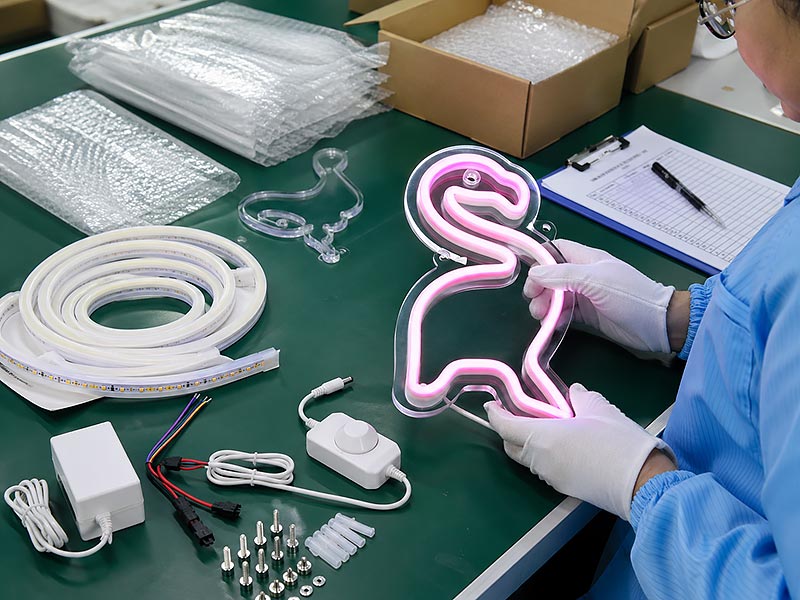
The LED strip decides whether the sign glows evenly or looks patchy. When the LED strip is poor, you may see dark spots, color differences, flickering, weak corners, or brightness loss after short use. These problems are very obvious in cafés, bars, salons, retail stores, and photo walls because people often take pictures close to the sign.
For commercial use, ask whether the LED system is designed for long working hours. A sign used in a restaurant, bar, gym, office, or retail store may run 8–12 hours per day. Over one year, that can mean roughly 3,000–4,000 working hours. If the LED strip, soldering, and power supply are not stable, problems may appear much earlier than expected.
| What to Check | Good Sign Performance | Warning Sign |
|---|---|---|
| Brightness | Even from start to end | Dark sections or weak corners |
| Color | Same tone across the sign | One letter looks warmer or cooler |
| Flicker | No visible flicker in videos | Flashing lines on camera |
| Heat | Warm but not excessive | Tube or adapter gets too hot |
| Long use | Stable after hours of lighting | Brightness drops quickly |
Ask for a short video of the sign turned on in normal room light, not only in a dark room. A sign always looks stronger in darkness. Real room lighting shows whether the brightness is strong enough for daily use.
For repeat orders, LED consistency becomes even more important, especially when the same logo will be used across different stores or client projects. If the factory changes LED strips without record control, the same design may look slightly different from batch to batch.
Neon Tube
The neon tube affects the shape, light softness, surface finish, and durability. Good LED neon tubing should have a smooth surface, clean bends, even light diffusion, and no obvious glue marks or dirty edges. When the tube quality is poor, the sign may look acceptable from far away but rough when viewed up close.
For logo signs and text signs, tube thickness should match the design. If the font is too thin, the neon tube may not bend cleanly. If the letters are too small, the inner spaces may close up and make the sign hard to read. This is why a good factory should review the artwork before production, not simply say yes to every design.
A practical rule: the more detailed the logo, the more carefully the neon layout needs to be adjusted. Very small letters, sharp corners, and thin script fonts may need thicker strokes, simplified lines, or a larger sign size.
| Design Detail | Possible Issue | Better Solution |
|---|---|---|
| Thin script font | Tube cannot bend smoothly | Increase letter size or stroke width |
| Small logo details | Details may disappear | Simplify or combine with printed acrylic |
| Tight corners | Uneven bending | Use smoother curves |
| Many color sections | More wiring and joints | Reduce colors or separate zones |
| Very small letters | Poor readability | Enlarge sign or change font |
The sign should look good both turned on and turned off. During daytime, people still see the tube, backing, wires, and finishing. For retail stores and office reception walls, daytime appearance matters almost as much as nighttime glow.
Acrylic Backing
The acrylic backing is the structure behind the sign. It affects strength, weight, installation, appearance, and shipping safety. If the backing is too thin for the sign size, it may bend, crack, or feel unstable. If it is too heavy, shipping cost increases and installation becomes harder.
For small indoor signs, a thinner acrylic backing may be acceptable. For medium and large commercial signs, stronger backing is safer. For event signs that are moved often, backing strength becomes even more important because the sign may be packed, unpacked, transported, and installed many times.
| Sign Size / Use | Backing Focus | Practical Advice |
|---|---|---|
| Small wall sign | Light and simple | Suitable for cafés, rooms, small displays |
| Medium logo sign | Balanced strength | Good for salons, gyms, retail walls |
| Large photo wall sign | Anti-bending strength | Needs stronger acrylic and better packing |
| Event backdrop | Reuse and transport | Avoid fragile thin backing |
| Office reception sign | Clean edge finish | Edge polishing and neat wire layout matter |
| Outdoor sign | Stronger structure | Needs waterproof planning and secure mounting |
The backing shape also changes the visual effect. A rectangular clear board is simple and easy to install. A cut-to-shape backing looks cleaner and more custom. A full panel may be better for fast installation, while contour cutting may be better for premium brand walls.
Ask for photos of the sign when it is turned off. This helps check scratches, edge quality, screw holes, wire position, and whether the backing looks clean enough for the space.
Brightness
Brightness should match the location. A sign that works well in a dark bar may feel too strong inside a small salon. A soft office logo may be too weak for a street-facing window. The best brightness is not the brightest one; it is the brightness that fits the viewing distance, surrounding light, wall color, and business purpose.
For indoor decorative signs, dimming is often useful. A café may want stronger brightness during the day and softer light at night. A photo wall may need lower brightness to avoid overexposed pictures. A gym or bar may prefer stronger contrast.
| Scene | Brightness Need | Recommended Choice |
|---|---|---|
| Café wall | Soft and photo-friendly | Dimmable warm white or brand color |
| Bar window | Strong visibility | Brighter single color or RGB |
| Salon mirror area | Soft, not harsh | Dimmer recommended |
| Gym wall | High energy | Stronger brightness and bold letters |
| Office reception | Premium and calm | Soft white, warm white, or halo-style look |
| Event backdrop | Camera control | Dimmer or remote control |
| Outdoor storefront | Long-distance visibility | Higher brightness and larger letters |
If the sign will be used for photos or videos, ask the factory to test it on camera. Some signs look fine to the eye but create flicker or overexposure in phone videos. This is especially important for restaurants, bars, weddings, exhibitions, and social-media walls.
A useful buying habit is to ask for two short videos:
- One video in a darker environment
- One video in normal room light
This gives a more realistic view of how the sign may look after installation.
Color Accuracy
Color is one of the most common reasons for disappointment. A color shown on a screen is not the same as a glowing LED color in a real space. A pink sign may look warm in a supplier photo but too purple after installation. A white sign may look clean in the factory but too cold on a beige wall.
For brand projects, color should be discussed early. Pantone colors are useful for reference, but LED light cannot always match printed color exactly. Wall color, room lighting, acrylic backing, camera settings, and surrounding decoration can all change the final visual effect.
Single-color LED is usually better for brand consistency. RGB is better when the sign needs mood changes, event flexibility, or color animation.
| Color Choice | Best For | Possible Issue |
|---|---|---|
| Warm white | Cafés, offices, premium interiors | May look yellow on some walls |
| Cool white | Clean modern spaces | Can feel harsh in small rooms |
| Red | Bars, restaurants, bold storefronts | Strong color, not suitable for every brand |
| Pink | Salons, boutiques, photo walls | Tone can vary between suppliers |
| Blue | Tech, gyms, nightlife | May feel cold indoors |
| RGB | Events, parties, entertainment | Less stable for fixed brand color |
| Brand color | Chain stores, logo signs | Needs careful sample confirmation |
For chain stores, always keep approved color records. If the first batch and second batch use different LED material, the same logo may look different across locations.
For strict brand projects, a physical sample or small color test can be more useful than a digital mockup. A mockup shows layout, but the real LED color must be checked through actual lighting.
Wiring
Wiring is a small detail that can ruin the final look if it is not planned correctly. A beautiful sign can look messy when the wire exits from the wrong side, hangs across the wall, or is too short to reach the power source.
Before production, confirm the wire exit position. Should the wire come out from the bottom right, bottom left, center back, top side, or behind the wall? A sign installed behind a reception desk may need hidden wiring. A window sign may need a longer cable. An event sign may need a plug-and-play setup.
| Wiring Detail | Why It Matters |
|---|---|
| Wire exit position | Affects visual cleanliness after installation |
| Cable length | Determines whether it reaches the outlet |
| Adapter position | Affects safety and appearance |
| Hidden wiring | Better for offices and premium retail spaces |
| External wiring | Easier for events and temporary displays |
| Waterproof connector | Important for outdoor or humid areas |
Ask the factory to mark the wire exit point on the design drawing. This small confirmation can prevent installation problems later.
For high-end office walls or chain-store projects, wire planning should be part of the interior design stage. Once the wall is finished, changing the wire route can be expensive and inconvenient.
Power Supply
The power supply is one of the most important safety parts. Many people focus on the sign body and forget the adapter. A poor adapter may cause unstable brightness, overheating, buzzing, or shorter product life.
For international orders, the adapter should match the plug standard and voltage requirements of the destination country. US, UK, EU, AU, and other markets may need different plug types. A professional manufacturer should confirm this before shipping.
| Power Detail | What to Confirm |
|---|---|
| Voltage | Usually 12V or 24V LED system |
| Plug type | US, UK, EU, AU, or other |
| Power capacity | Must match sign size and LED load |
| Adapter quality | Stable output and safe operation |
| Indoor/outdoor use | Outdoor needs protected power placement |
| Spare adapter | Useful for commercial and event use |
For large signs, one adapter may not always be enough. The factory may need to divide the sign into sections or use a higher-capacity power supply. If the supplier does not calculate the power load properly, the sign may be weak, unstable, or unsafe.
For commercial use, it is wise to order spare adapters, especially for event companies, sign shops, and chain-store projects. A spare adapter is cheaper than losing business because a sign cannot turn on.
Waterproof Level
Waterproof quality should be judged by the actual use environment, not by one simple word like “outdoor.” A sign under a covered entrance has different needs from a sign exposed to direct rain. A sign inside a humid bar or near a restaurant patio may also need better protection than a normal indoor wall sign.
For outdoor or semi-outdoor use, the important areas are tube sealing, wire connection, power supply placement, controller protection, and installation angle. Even if the tube is waterproof, water can still create problems if it reaches the adapter or connector.
| Use Environment | Quality Requirement |
|---|---|
| Dry indoor wall | Standard indoor structure is usually enough |
| Salon or gym | Better dust resistance and easy cleaning |
| Restaurant entrance | Consider humidity and cleaning conditions |
| Covered outdoor area | Semi-outdoor waterproof design recommended |
| Open outdoor wall | Outdoor-grade sealing and secure mounting needed |
| Outdoor event | Waterproof planning plus safe temporary wiring |
| Coastal area | Stronger anti-corrosion thinking may be needed |
Do not use an indoor sign outdoors just to save cost. It may work for a short time, but water, heat, dust, and sunlight can shorten its life. If the sign will face rain, strong sun, or humidity, tell the factory before quotation.
Installation Parts
A good sign should arrive with the correct installation accessories. Missing screws, weak chains, short cables, or unclear mounting holes can delay installation and make the final result look less professional.
Installation method depends on the sign size, wall surface, and use scenario. A small indoor sign may only need pre-drilled holes and screws. A premium office logo may need stand-off screws. An event sign may need chains or a portable frame. A large outdoor sign may need stronger brackets and local professional installation.
| Installation Method | Best Use |
|---|---|
| Pre-drilled holes | Common wall-mounted signs |
| Stand-off screws | Premium office and retail walls |
| Hanging chain | Windows, events, temporary displays |
| Back frame | Large or irregular signs |
| Brackets | Outdoor or heavier signs |
| Installation template | Chain stores and repeat projects |
Ask for a simple installation guide. It does not need to be complicated, but it should show where the holes are, what accessories are included, and how the sign should be fixed.
For chain-store projects, installation templates are very useful. They help different local installers place the sign in the same position and keep a consistent brand look.
Packaging
Packaging is where many international sign orders fail. The sign may be well made, but if the packing is weak, the acrylic can crack, the tube can be pressed, the corners can break, or the adapter can scratch the surface during shipping.
Good packaging should protect the sign from pressure, vibration, corner impact, and internal movement. Accessories should be packed separately so screws and adapters do not rub against the acrylic.
| Packaging Detail | Why It Matters |
|---|---|
| Foam around the sign | Reduces vibration during shipping |
| Corner protection | Prevents acrylic cracking |
| Separate accessory bag | Avoids scratches from screws and adapters |
| Surface film | Protects acrylic from small scratches |
| Strong carton | Handles courier movement better |
| Wooden crate | Useful for large or high-value signs |
| Clear label | Helps warehouse and installer identify parts |
For large signs, irregular shapes, export orders, and bulk shipments, packaging should be discussed before production finishes. A slightly stronger package may add cost, but it can prevent much larger losses.
For resellers and sign companies, packaging also affects the final client experience. A clean box, organized accessories, and clear instructions make the product feel more professional when the client receives it.
Quality Inspection
Quality inspection should happen before shipping, not after the sign arrives. A reliable factory should check appearance, lighting, wiring, adapter, accessories, and packaging before dispatch.
A practical pre-shipment inspection should include:
| Inspection Item | What Should Be Checked |
|---|---|
| Artwork accuracy | Logo shape, text spelling, size, layout |
| Lighting | Even brightness, no dark spots, no flicker |
| Color | Correct LED color or RGB function |
| Acrylic | No cracks, deep scratches, dirty edges |
| Wiring | Correct exit position, stable connection |
| Adapter | Correct plug and power output |
| Controls | Dimmer, remote, RGB controller working |
| Accessories | Screws, chains, spacers, manual included |
| Packaging | Foam, carton, labels, protection complete |
Ask the factory to send photos and videos before shipping. The video should show the sign turned on, the dimmer or remote working if included, and close-up views of the finish. For larger projects, ask for packaging photos too.
Quality inspection for custom signs cannot be only a quick visual check. Every project has different drawings, materials, sizes, colors, accessories, and packaging requirements. The finished product should be compared with the approved production details before it leaves the factory.
Real Use Test
A sign should not only pass a quick “turn on” test. For commercial use, it should be tested like a real product. That means checking whether it can stay lit, whether the adapter remains stable, whether the dimmer works smoothly, and whether the brightness looks even after running for a period of time.
For high-value projects, ask whether the factory performs an aging test or lighting test before shipment. Even a short continuous lighting test can reveal flicker, unstable connections, heat problems, or weak sections.
A useful test process includes:
- Turn on the full sign
- Check every letter or shape
- Test the dimmer or remote
- Keep the sign running for a period of time
- Check adapter heat
- Confirm no flicker or dark section
- Take final photos and video
- Pack only after the test is passed
This is especially important for signs used in bars, restaurants, gyms, retail windows, and offices where the sign may run for many hours every day.
Common Red Flags
Some problems can be noticed before placing the order. If a supplier cannot answer basic technical questions, does not ask about the use environment, or gives the same answer for every project, be careful.
Common red flags include:
| Red Flag | Why It Is Risky |
|---|---|
| Only gives price, no technical questions | May not understand real project needs |
| No photo or video before shipping | You cannot check quality in advance |
| Very low price with unclear details | Material or packaging may be reduced |
| No plug type confirmation | Power adapter may not fit your market |
| No discussion of indoor/outdoor use | Wrong structure may be produced |
| No packaging explanation | Higher damage risk during shipping |
| No warranty clarity | Hard to solve problems later |
| No drawing confirmation | Logo, size, or wire position may be wrong |
A good manufacturer will not make the process feel complicated for no reason. It will ask the right questions early so the final sign is easier to produce, ship, install, and use.
For international custom LED neon sign projects, real quality is not one single feature. It is the result of many small decisions made correctly: proper LED strip, smooth tube bending, strong backing, clean wiring, safe adapter, suitable waterproof level, complete accessories, strong packaging, and careful inspection before shipping.
How Much Does a Custom LED Neon Sign Cost?
A custom LED neon sign price is usually affected by size, design complexity, tube length, LED color, backing material, waterproof level, control system, order quantity, packaging, and shipping method. A small indoor text sign may be simple and affordable, while a large outdoor logo sign with RGB control, reinforced structure, and export packaging will cost much more.
Price becomes easier to understand when you stop asking only, “How much is one sign?” and start asking, “What is included in this quote?” Two suppliers may give very different prices for the same logo because they are not quoting the same product structure.
One quote may include a thicker acrylic backing, dimmer, adapter, installation accessories, stronger packaging, and pre-shipment testing. Another quote may include only the basic sign body. From the outside, both may look similar. After delivery, the difference becomes clear.
Main Price Factors
The price of a custom LED neon sign is not based only on width or height. A 100 cm simple text sign can be easier and cheaper than a 70 cm detailed logo sign with many curves, small letters, and several colors.
The main cost factors include:
| Cost Factor | Why It Changes Price |
|---|---|
| Size | Larger signs use more tube, acrylic, labor, and packaging |
| Design complexity | Detailed logos need more bending and assembly time |
| Tube length | More light lines mean more material and labor |
| LED color | RGB or special colors may cost more than standard colors |
| Backing material | Clear acrylic, colored acrylic, metal, and custom shapes differ |
| Waterproof level | Outdoor signs need more sealing and protection |
| Control system | Dimmer, remote, RGB controller, or app control adds cost |
| Quantity | Bulk orders can reduce unit price |
| Packaging | Large or fragile signs may need stronger packing |
| Shipping | Cost changes by destination, size, volume, and method |
A supplier should ask for basic project details before giving a serious quote. If the price is given without size, design, use environment, color, plug type, and quantity, it is only a rough estimate.
A clear quote should mention:
- Final sign size
- Design version
- LED color
- Indoor or outdoor use
- Backing material
- Adapter and plug type
- Dimmer or remote
- Installation accessories
- Packaging method
- Production time
- Shipping method
- Warranty terms
This makes comparison much easier.
Size and Complexity
Size is easy to understand. Bigger signs usually cost more. But design complexity can change price just as much as size.
A simple word such as “Open” is easier to make than a detailed restaurant logo with script letters, small icons, and multiple color zones. Thin fonts, tight corners, small decorative lines, and separated logo elements take more time to produce.
Common complexity drivers include:
- Script fonts with many curves
- Very small letters
- Detailed logo icons
- Multiple colors
- Separated shapes
- Sharp corners
- Long slogans
- Layered design
- Mixed materials
| Design Type | Production Difficulty | Cost Logic |
|---|---|---|
| Simple one-word sign | Low | Less tube and labor |
| Short slogan | Low to medium | Depends on letter size and font |
| Logo + text | Medium | Needs layout balance and accuracy |
| Detailed logo | Medium to high | More bending and assembly time |
| Multi-color sign | Higher | More wiring and material zones |
| Large outdoor sign | Higher | More structure, sealing, and packaging |
Sometimes the factory may suggest changing the design slightly to reduce cost. This does not mean lowering quality. It may mean making the sign easier to read, easier to bend, and safer to ship.
For example, simplifying a small logo detail or increasing the letter size can improve both appearance and production stability.
Colors and RGB
Color affects both cost and user experience. A fixed single-color LED neon sign is usually simpler, cleaner, and more stable for brand use. RGB signs offer more flexibility but require extra controllers, remotes, wiring, and user instructions.
Single-color signs are usually better for:
- Brand logo signs
- Chain stores
- Office reception walls
- Retail shop interiors
- Restaurants with fixed visual identity
- Sign companies that need repeatable color quality
RGB signs are usually better for:
- Events
- Parties
- Bars
- Stage backdrops
- Entertainment spaces
- Temporary displays
- Projects that need changing mood or theme
| Color Option | Best Use | Cost / Risk Note |
|---|---|---|
| Single warm white | Cafés, offices, soft interiors | Stable and elegant |
| Single cool white | Modern retail, clean design | Can look sharp or cold |
| Red / pink / blue | Bars, salons, gyms, boutiques | Strong visual personality |
| RGB | Events, parties, nightlife | More parts, more control complexity |
| Brand color | Chain stores, logo signs | Needs careful sample confirmation |
RGB is not always “better.” For a luxury office wall, RGB may feel less premium than a clean warm white logo. For a chain brand, RGB may cause inconsistency if different stores use different color modes. For an event company, RGB can be valuable because one sign can match different themes.
For brand-sensitive projects, ask for real photos, videos, or a color sample before bulk production.
Indoor and Outdoor Cost
Outdoor LED neon signs usually cost more because they need stronger protection. Outdoor use may require better sealing, waterproof wiring, protected power connection, UV-resistant thinking, stronger backing, and safer mounting.
The extra cost is not only material cost. It also comes from more careful production and testing.
| Use Environment | Cost Level | Why |
|---|---|---|
| Indoor dry wall | Lower | Standard structure is usually enough |
| Indoor commercial space | Medium | Better finish and accessories may be needed |
| Semi-outdoor covered area | Medium to higher | Needs better protection |
| Open outdoor wall | Higher | Requires waterproofing and stronger installation |
| Outdoor event | Higher | Needs waterproof planning and temporary power safety |
| Coastal or humid area | Higher | Needs more careful material and wiring planning |
Some people try to use indoor signs outdoors to save money. This is risky. An indoor sign may work for a short time outside, but rain, sunlight, humidity, and dust can shorten its life quickly.
A better way to control outdoor cost is to describe the environment clearly:
- Is the sign under a roof?
- Will it face direct rain?
- Will it face strong sunlight?
- Is the area humid?
- Is it close to the sea?
- How high will it be installed?
- Will a local electrician install it?
- Where will the power adapter be placed?
The factory can then recommend the right structure without overbuilding or underbuilding the sign.
Sample and Bulk Orders
Samples and bulk orders have different cost logic.
A sample is usually used to confirm quality, color, brightness, backing, wire position, packaging, and communication process. It may not have the lowest unit price because design setup and production preparation are spread over only one piece.
Bulk orders may reduce unit cost because the factory can prepare materials, drawings, and production steps more efficiently.
| Order Type | Main Purpose | Cost Logic |
|---|---|---|
| 1-piece sample | Test quality and design | Higher unit cost but lower risk |
| Small batch | Store opening, event, reseller test | Moderate unit price |
| Bulk order | Chain stores, wholesale, repeat sales | Lower unit price possible |
| Repeat order | Same design reordered | Usually easier and faster |
| Mixed custom batch | Many different designs | Cost depends on design variation |
For sign companies, resellers, event planners, and chain-store teams, a sample can become the approved standard for future production. After the sample is approved, the factory should keep production records. This makes repeat orders faster and more consistent.
Packaging and Shipping Cost
Packaging and shipping are often underestimated. A large LED neon sign may not be very heavy, but it can have a large shipping volume. Courier companies often calculate shipping by dimensional weight, not only actual weight.
A large acrylic sign may cost more to ship because the package is wide and needs enough protection around the edges.
| Cost Item | Why It Matters |
|---|---|
| Foam protection | Adds volume but reduces damage risk |
| Strong carton | Better for courier handling |
| Wooden crate | Higher cost but safer for large signs |
| Separate accessories | Prevents scratches |
| Shipping volume | Affects freight cost |
| Destination country | Affects freight and customs |
| Shipping method | Courier, air, sea, or forwarder differ |
Do not judge shipping cost only by product weight. A lightweight but large sign can still be expensive to ship.
For small samples, express courier is often convenient. For bulk orders, air freight or sea freight may be more cost-effective. For very large signs, packaging design should be discussed early because the shipping size can affect the total cost strongly.
How to Compare Quotes
Comparing only the final number is dangerous. A cheaper quote may exclude adapter, dimmer, installation accessories, strong packaging, warranty support, or shipping. It may also use thinner acrylic or weaker components.
Use a quote comparison table:
| Quote Item | Supplier A | Supplier B | Supplier C |
|---|---|---|---|
| Sign size | |||
| Design version | |||
| Indoor/outdoor | |||
| LED color | |||
| Acrylic thickness | |||
| Backing shape | |||
| Adapter included | |||
| Plug type | |||
| Dimmer/remote | |||
| Installation accessories | |||
| Packaging method | |||
| Production time | |||
| Shipping cost | |||
| Warranty | |||
| OEM support | |||
| Reorder records |
This table helps show whether the lower price is truly better or only looks cheaper because important items are missing.
The goal is not to buy the most expensive sign. The goal is to buy a sign with clear specifications, suitable quality, safe packaging, and fewer surprises.
How to Reduce Cost Without Looking Cheap
Cost control does not mean making the sign poor. A good manufacturer can help reduce unnecessary cost while keeping the sign attractive and reliable.
Useful ways to control cost include:
- Use a clean font instead of very thin script
- Avoid unnecessary tiny logo details
- Choose one or two strong colors instead of many colors
- Confirm indoor or outdoor use early
- Use standard clear acrylic when suitable
- Keep the sign size practical for the viewing distance
- Use a dimmer only when brightness control is needed
- Use RGB only when color-changing is truly useful
- Standardize signs for repeat orders
- Order samples before large production
- Use stronger packaging for valuable signs instead of risking damage
For example, a restaurant logo may not need five colors. A two-color design may look cleaner, cost less, and be easier to produce. A chain-store sign may save money by using one standard size and backing structure for all locations. An event company may save money by designing reusable signs instead of one-time fragile decorations.
Price should be optimized together with design, not after the design is already too complicated.
What Price Range Should You Expect?
Because every custom LED neon sign is different, there is no single fixed price that applies to all projects. A small indoor slogan sign, a large waterproof storefront sign, and a batch of chain-store logo signs are not in the same price category.
A practical way to think about price is by project type:
| Project Type | Cost Level | Main Reason |
|---|---|---|
| Small indoor text sign | Lower | Simple design, less material |
| Medium logo wall sign | Medium | Custom layout and stronger backing |
| Photo-wall sign | Medium | Needs clean appearance and balanced brightness |
| RGB event sign | Medium to higher | Controller and color-changing system |
| Outdoor storefront sign | Higher | Waterproofing and stronger structure |
| Logo + slogan + icon set | Higher | More components and assembly |
| Chain-store batch signs | Depends on quantity | Unit cost may reduce with standardization |
The final budget should include more than the product price. Think about:
- Design or mockup
- Product cost
- Dimmer or controller
- Adapter and plug
- Installation accessories
- Packaging
- Shipping
- Customs duty or tax
- Local installation
- Spare parts if needed
A sign that looks cheap in the quotation may become expensive after shipping, customs, damage risk, and installation delays are added.
When a Higher Price Is Worth It
A higher price can be worth it when the project has higher business value or higher risk.
A sign used for a chain-store rollout should not be treated like a cheap decorative sign. If the color is inconsistent across stores, the brand image suffers. A sign for a trade show booth must arrive on time and work properly because the event date cannot be delayed. A sign for an office reception wall should look clean during both daytime and nighttime because clients see it closely.
A higher price may be justified when it includes:
- Better LED strips
- Stronger acrylic backing
- Cleaner tube bending
- Accurate logo conversion
- Better adapter
- Dimmer or remote control
- Outdoor waterproof treatment
- Stronger packaging
- Pre-shipment testing
- Export documents
- Warranty support
- Repeat-order records
The wrong place to save money is often packaging, adapter quality, and design review. These parts are not always exciting, but they prevent real problems.
For sign companies, resellers, event planners, and chain-store teams, the best price is not always the lowest unit cost. It is the price that gives the right balance between appearance, reliability, delivery safety, and future cooperation.
How Do You Choose a Reliable Manufacturer?
A reliable custom LED neon sign manufacturer should help prevent mistakes before production starts. Look for real factory experience, design support, clear material advice, MOQ flexibility, sample ability, stable production capacity, export packaging, QC inspection, warranty support, and repeat-order records. For international custom signage projects, the right manufacturer should make the whole process clearer, safer, and easier to repeat.
Choosing a manufacturer is different from buying a ready-made sign online. A ready-made sign has fixed size, fixed color, fixed wiring, and fixed packaging. A custom LED neon sign is built around your logo, wall size, local plug standard, installation method, brightness expectation, and sometimes your own client’s brand requirements.
That is why the cheapest quote is not always the safest quote. A low price may look attractive at first, but if the sign arrives with the wrong color, weak acrylic, messy wiring, missing accessories, or poor packaging, the real cost becomes much higher. For international orders, returning or repairing a large sign is slow and expensive.
A good manufacturer should help answer real project questions:
| Key Question | Why It Matters |
|---|---|
| Can this logo be made clearly in LED neon? | Some thin lines and small details may need adjustment |
| Is the sign indoor, semi-outdoor, or outdoor? | Material, sealing, and wiring are different |
| What plug and voltage are needed? | US, UK, EU, AU, and other markets need different adapters |
| How will the sign be installed? | Wall-mounted, hanging, event, and storefront signs need different parts |
| How will it be packed for export? | Poor packaging can crack acrylic or damage the neon tube |
| Is this a one-time order or repeat project? | Repeat orders need saved production records |
For restaurants, cafés, salons, bars, gyms, offices, event companies, sign shops, and chain stores, the manufacturer should act like a production partner. The job is not finished when the sign lights up in the factory. The real test is whether the sign arrives safely, installs smoothly, looks right in the actual space, and can be reordered with the same quality later.
Factory Experience
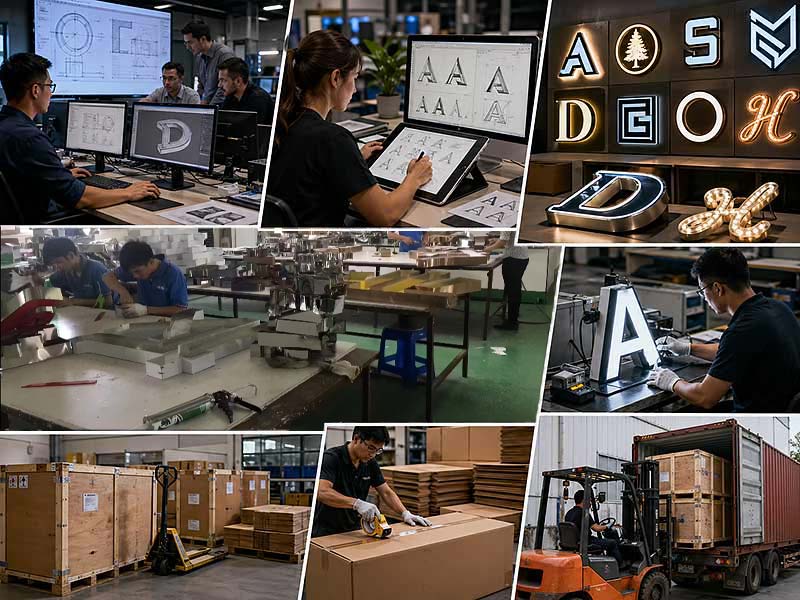
Factory experience matters because custom LED neon signs involve many small decisions. A new or purely trading supplier may be able to sell a simple wall sign, but complex commercial projects need stronger production control.
A bar window sign may need higher brightness and stronger visual contrast. A salon mirror sign may need softer light and clean wire placement. An outdoor storefront sign may need better waterproof treatment. A chain-store logo sign may need the same color, size, backing shape, and plug type across many locations.
An experienced factory usually notices problems early:
| Project Problem | Experienced Factory Response |
|---|---|
| Logo lines are too thin | Suggests thicker strokes or larger size |
| Small text is hard to read | Recommends a simpler font or larger sign |
| Sign will be used outdoors | Recommends waterproof structure and protected wiring |
| Wall is dark or textured | Suggests stronger brightness or suitable backing |
| Sign is for photos | Recommends dimmer and camera-friendly brightness |
| Order may repeat later | Saves drawings, color notes, and material records |
| Large sign may bend in shipping | Suggests stronger backing and reinforced packaging |
A factory with real experience will not say “yes” to every design blindly. If a design is risky, it should explain why. That kind of honest advice can save time, money, and disappointment.
Product Range
A reliable manufacturer should have enough product range to match different commercial needs. If the supplier only makes one type of LED neon sign, it may force every project into the same solution, even when another structure would work better.
A small café quote sign may be perfect with flexible LED neon on clear acrylic. A luxury office reception logo may look better with backlit channel letters. A retail storefront may need front-lit channel letters instead of indoor neon. An event company may need marquee letters for a vintage wedding setup. A sign company may need LED neon, light boxes, and channel letters from the same factory to serve different local clients.
A practical product range may include:
| Product Type | Best Use |
|---|---|
| Flexible LED neon signs | Cafés, bars, salons, gyms, photo walls |
| LED logo signs | Reception walls, retail interiors, brand displays |
| Front-lit channel letters | Storefronts, shopping streets, commercial facades |
| Backlit channel letters | Offices, premium interiors, brand walls |
| Dual-lit channel letters | High-impact storefronts and modern brand signs |
| Light boxes | Retail windows, menus, wayfinding, outdoor signs |
| Marquee letters | Weddings, events, parties, retro-style decoration |
| LED neon + acrylic combinations | Clean indoor commercial displays |
| LED neon + metal combinations | More durable or premium projects |
This range gives more flexibility. A good factory can recommend the right structure instead of pushing the same product every time.
For example:
- If a boutique wants a soft photo-wall sign, LED neon may be the best choice.
- If a restaurant wants an outdoor entrance logo, channel letters may be stronger.
- If an event planner wants reusable wedding signs, marquee letters may create better value.
- If an office wants a premium logo wall, backlit or dual-lit letters may look more professional.
For buyers who need different signage types across one project, working with a manufacturer that supports LED neon, channel letters, light boxes, marquee letters, and mixed-material signs can reduce supplier management work.
Design Support
Design support is one of the easiest ways to tell whether a manufacturer understands custom signage. A good factory should not simply copy your logo into a neon layout. It should check whether the design can be produced clearly, safely, and attractively.
Many logos are designed for screens, packaging, websites, or business cards. They are not automatically suitable for LED neon tubing. Thin lines, small text, sharp corners, gradients, and tiny details may not work well when converted into physical neon lines.
Good design support should include:
| Design Support Item | Why It Helps |
|---|---|
| Free mockup | Helps you see the layout before production |
| Size suggestion | Avoids signs that are too small or too large |
| Font adjustment | Improves readability and tube bending |
| Logo simplification | Keeps the sign clean and producible |
| Color advice | Helps match brand style and real lighting effect |
| Wire position planning | Makes installation cleaner |
| Backing shape suggestion | Improves visual finish and mounting logic |
| Installation review | Reduces problems after delivery |
A script-style café logo may look beautiful on a menu, but some letters may connect too tightly for LED neon. The factory may suggest making the sign wider, increasing line thickness, or separating some strokes. A gym slogan may need bolder letters because people view it from a distance. A salon wall sign may need softer curves and warm color to match the interior.
If you do not have technical signage drawings, send a logo, sketch, reference photo, wall picture, or basic text idea. A capable design team should be able to turn that into a more practical production layout.
MOQ and Sampling
MOQ matters because custom signage often starts with testing. A restaurant may need one logo sign before opening. A sign company may want to test a new factory before sending repeat orders. A chain store may need one approved sample before producing signs for multiple locations.
A low MOQ reduces risk. It gives you a way to check real quality before committing to a larger order. For custom LED neon signs, MOQ from 1 piece is especially useful because every project can have a different logo, size, color, and installation condition.
Sampling is not only about receiving a small sign. It helps confirm the full production process:
| Sample Check | What You Can Confirm |
|---|---|
| Shape accuracy | Whether the logo or text matches the approved design |
| LED color | Whether the real glow fits the brand or space |
| Brightness | Whether the sign is too strong, too weak, or just right |
| Acrylic finish | Whether the backing looks clean and solid |
| Wire position | Whether installation will look tidy |
| Accessories | Whether screws, chains, or spacers are suitable |
| Packaging | Whether the product can survive shipping |
| Communication | Whether the factory responds clearly and quickly |
A serious sample is also a future reference. Once approved, the sample should become the standard for bulk orders. The factory should record the size, color, backing, tube type, adapter, packaging, and any special details. This is very important for chain stores, sign companies, and repeat orders.
Production Capacity
Production capacity becomes important when the project is bigger than one sign. A small supplier may handle a single wall sign, but larger orders need enough workers, equipment, production lines, designers, engineers, and QC staff.
An event company may need 30 custom signs before a trade show. A sign company may need different client orders every week. A chain store may need standardized logo signs for many locations. In these cases, the question is not only “Can you make this?” but also “Can you make this on time, with consistent quality?”
Production capacity affects:
| Capacity Factor | Why It Matters |
|---|---|
| Production lines | More orders can be handled at the same time |
| Skilled workers | Cleaner bending, wiring, assembly, and finishing |
| Designers | Faster mockups and artwork adjustment |
| Engineers | Better solutions for special structures |
| QC team | More careful inspection before shipping |
| Material supply | Shorter waiting time for common components |
| Packaging team | Better export preparation |
Capacity alone is not enough. The factory also needs organization. A large factory without good order management can still make mistakes. Ask how the factory confirms drawings, tracks production details, checks quality, and manages reorders.
Material Control
Material control decides whether the first order and second order look the same. This is especially important for brand signs, chain stores, resellers, and sign companies.
If the supplier changes LED strips, acrylic type, tube material, or adapter model without telling you, the reorder may look different. The color may shift. The brightness may change. The acrylic edge may look cheaper. The power adapter may not match the original standard.
A reliable manufacturer should control and record key materials:
| Material Detail | Why It Should Be Recorded |
|---|---|
| LED color and strip type | Keeps brightness and color stable |
| Neon tube type | Keeps glow thickness and surface look consistent |
| Acrylic thickness | Keeps strength and appearance consistent |
| Backing shape | Keeps brand visual standard |
| Adapter model | Keeps electrical performance stable |
| Dimmer or controller | Keeps user experience consistent |
| Packaging method | Keeps shipping protection consistent |
For one-time decorative signs, small differences may not matter much. For chain-store projects, they matter a lot. Imagine 20 stores using the same logo sign, but five signs look slightly bluer and three signs look less bright. That damages brand consistency.
Before bulk production, ask whether the factory can keep approved material records. If the order may repeat in the future, make this clear from the beginning.
Quality Inspection
Quality inspection should happen before the sign leaves the factory. For international orders, it is much cheaper to find problems before shipping than after delivery.
A proper inspection is more than turning the sign on for a few seconds. The factory should check the design, appearance, lighting, wiring, adapter, accessories, packing, and order details.
A practical inspection list includes:
| Inspection Item | What Should Be Checked |
|---|---|
| Text and logo | Correct spelling, shape, size, and layout |
| LED lighting | No dark spots, flicker, or uneven brightness |
| Color | Matches approved order details |
| Acrylic | No cracks, deep scratches, or dirty edges |
| Tube bending | Smooth curves and clean corners |
| Wiring | Correct exit position and stable connection |
| Adapter | Correct plug, voltage, and power output |
| Control parts | Dimmer, remote, or RGB controller works properly |
| Accessories | Screws, chains, spacers, or brackets included |
| Packaging | Foam, corner protection, labels, carton strength |
Ask for pre-shipment photos and videos. The video should show the sign turned on, the dimmer or remote working if included, and close-up shots of the surface and wiring. For larger signs, ask for packaging photos before shipment.
Inspection must compare the finished product against the approved project details, not only against a general standard. This is especially important for custom signs because each order may have different drawings, colors, sizes, backing shapes, accessories, and packaging requirements.
Export Packaging
Export packaging is not a small detail. It can decide whether the sign arrives ready to install or arrives damaged.
LED neon signs often include acrylic backing, silicone tubing, wiring, adapters, and control parts. Acrylic can crack under pressure. Tube sections can be damaged if the package is squeezed. Accessories can scratch the surface if they are not packed separately.
A reliable manufacturer should choose packaging based on sign size, shape, shipping method, and destination.
| Sign Situation | Recommended Packaging Focus |
|---|---|
| Small indoor sign | Foam protection and strong carton |
| Medium acrylic sign | Corner protection and anti-scratch film |
| Large sign | Reinforced carton or wooden crate |
| Irregular shape | Custom foam support |
| Bulk order | Clear labels and organized accessories |
| Reseller order | Clean packaging and user-friendly accessory bags |
| Event sign | Reusable protection if the sign will be moved often |
For courier shipping, the package may be handled many times. For air or sea shipping, stacking pressure and warehouse movement also matter. A good factory should think about the full journey, not only the product leaving its door.
For resellers and sign companies, packaging also affects the final client experience. A clean accessory bag, simple instruction sheet, and tidy cable arrangement make the product feel more professional.
Communication Speed
Communication speed is not only about replying fast. It is about replying clearly.
A reliable manufacturer should understand your question, ask for missing details, and give practical answers. Fast but vague replies do not help. Slow replies can delay store openings, event dates, or client approvals.
Good communication usually looks like this:
| Good Communication | Poor Communication |
|---|---|
| Confirms size, color, use environment, and plug type | Sends price without asking details |
| Explains why a design may need adjustment | Says every design is “no problem” |
| Provides mockup or drawing before production | Starts production with unclear artwork |
| Sends photos or videos before shipping | Ships without confirmation |
| Keeps records for repeat orders | Asks for the same details again every time |
| Explains lead time honestly | Promises unrealistic delivery |
For international orders, time zone differences already slow things down. Clear communication becomes even more important. If the factory can help avoid five rounds of repeated explanation, the project moves faster.
For sign companies and interior designers, communication quality is also part of service value. You may need to answer your own client quickly. A factory that provides clear drawings, photos, and production updates makes your side of the business easier.
OEM and ODM
OEM and ODM support matters for sign companies, resellers, design studios, event companies, and chain brands. These clients usually do not want a random supplier label. They need signs that can fit their own brand, sales process, packaging style, and project workflow.
OEM support may include:
- Custom logo labels
- Neutral packaging
- Branded instruction sheets
- Repeat-order records
- Custom packaging design
- Product photo support
- Consistent specifications for resale
- Private-label cooperation
ODM support may include:
- New product development
- Custom structure design
- Special backing shapes
- Material combination suggestions
- LED neon + acrylic + metal combinations
- Event display solutions
- Storefront sign system development
A local sign company may receive many different client requests but does not own a production workshop. It needs a factory that can turn drawings into finished signs, pack them safely, and support repeat orders. An event planning company may want a series of wedding neon signs that can be reused and rented out. A chain brand may need a standardized sign kit for new stores.
In project-based cooperation, OEM/ODM support is valuable because it helps the client build a repeatable product or project system, not just complete one order.
Lead Time
Lead time should be realistic. A supplier that promises everything too fast may create risk. Custom LED neon signs need design confirmation, material preparation, production, testing, packing, and shipping. If any detail is unclear, rushing production can cause mistakes.
A normal project timeline usually includes:
| Step | What Happens |
|---|---|
| Requirement confirmation | Size, design, usage, color, plug, quantity |
| Mockup or drawing | Visual layout and production structure |
| Quotation | Price based on confirmed details |
| Sample or production | Manufacturing begins after approval |
| Quality inspection | Lighting, appearance, wiring, accessories |
| Packaging | Foam, carton, labels, protection |
| Shipping | Courier, air, sea, or forwarder arrangement |
For simple samples, a short production cycle may be possible. For special structures, new molds, outdoor waterproofing, or bulk orders, more time should be planned. Bulk order timing depends on quantity, design complexity, and the current production schedule.
For projects with a store opening, exhibition, wedding, or campaign launch, plan backward from the final installation date. Include time for design approval, production, shipping, customs, local delivery, and installation. A sign that arrives one day before opening gives no room for correction.
Warranty and After-Sales
Warranty is important, but the real question is how the supplier handles problems. A long warranty sentence is not useful if the factory does not respond after delivery.
Before ordering, warranty details should be clear.
Ask these questions:
| Warranty Question | Why It Matters |
|---|---|
| Which parts are covered? | LED strip, adapter, controller, or full sign may differ |
| What if the sign arrives damaged? | Shipping damage needs fast handling |
| What proof is needed? | Photos and videos are usually required |
| Are spare parts available? | Adapters and controllers may need replacement |
| Is outdoor misuse covered? | Indoor signs used outdoors may not be protected |
| How fast can the factory respond? | Delays affect business use |
Good after-sales support should help diagnose the problem first. Sometimes the issue is not the sign body. It may be the adapter, remote, connection, dimmer, or installation environment. A factory that understands the product can guide you more efficiently.
For sign companies and resellers, after-sales support is even more important because your client expects you to solve the issue. A factory that can provide spare parts, records, and technical guidance protects your relationship with your own customers.
Repeat Orders
Repeat-order support is one of the clearest signs of a reliable manufacturer. Many projects start with one sign, but successful projects often lead to more orders.
A restaurant may open a second location. A sign company may need another logo sign for a new client. An event company may reorder popular wedding signs. A chain store may roll out signs to more branches. If the factory does not keep records, every reorder becomes a new project from zero.
A reliable factory should save:
| Record Type | Why It Helps |
|---|---|
| Artwork file | Keeps logo and layout consistent |
| Size record | Avoids measuring again |
| LED color | Keeps visual consistency |
| Tube type | Keeps glow style the same |
| Acrylic thickness | Keeps strength and appearance |
| Adapter and plug | Keeps market compatibility |
| Wire position | Keeps installation the same |
| Packaging method | Keeps shipping protection stable |
| Sample photos | Helps compare future production |
In long-term wholesale or project-based cooperation, the real value is not only the first order. It is the ability to make the second, third, and tenth order easier.
You do not need to explain the same project again. You can say, “Repeat the previous logo sign, same size and color,” and the factory should know what to do.
This is especially important for chain-store signage. The goal is not just making many signs. The goal is making many signs that look like they belong to the same brand.
Manufacturer Checklist
Before choosing a custom LED neon sign manufacturer, use a simple checklist. If a supplier cannot answer most of these questions clearly, the risk is higher.
| Checklist Item | Good Answer Looks Like |
|---|---|
| Can they review your design? | They explain what works and what may need adjustment |
| Can they make a free mockup? | They provide a clear visual or production layout |
| Can they confirm indoor/outdoor use? | They recommend suitable structure and waterproof level |
| Can they confirm plug type? | They support your destination country |
| Can they explain material choices? | They discuss tube, acrylic, adapter, and accessories |
| Can they support sample orders? | You can test quality before larger orders |
| Can they provide realistic timing? | They give lead time based on project difficulty |
| Can they handle bulk orders? | They have production capacity and QC support |
| Can they pack for export? | They explain foam, carton, labels, or wooden crate options |
| Can they support warranty? | They explain what is covered and how problems are handled |
| Can they keep reorder records? | They can repeat approved signs later |
The best manufacturer is not always the one with the lowest unit price. It is the one that can help avoid wrong design, wrong material, wrong color, wrong plug, poor packing, delayed delivery, and difficult reorders.
For international custom LED neon sign projects, choose a manufacturer that understands both the product and the business situation behind it. A restaurant needs visual attraction. A salon needs atmosphere. A sign company needs stable supply. An event planner needs fast setup and reuse. A chain store needs consistency. A reliable manufacturer should understand these differences and build the sign around the real use case, not just around a product photo.
How Do Production, Shipping, and Installation Work?
A custom LED neon sign project usually moves through requirement confirmation, artwork checking, design mockup, quotation, production, quality inspection, packaging, shipping, and installation. The smoothest international orders usually start with clear confirmation of size, color, plug type, waterproof level, wire position, packaging, and installation method before production begins.
Production, shipping, and installation are closely connected. A sign is not finished when the neon tube lights up in the factory. It still needs to survive packing, warehouse handling, courier movement, customs clearance, local delivery, and final installation on a real wall.
A café owner may care most about whether the sign arrives before opening day. A sign company may care about whether the product can be installed quickly by a local crew. An event planner may care about whether the sign can be packed again and reused. A chain-store team may care about whether every branch receives the same accessories, same cable length, and same installation template.
A reliable manufacturer should think through the full journey:
| Step | What Should Be Confirmed | Why It Matters |
|---|---|---|
| Design | Logo, text, size, color, backing shape | Prevents wrong production |
| Engineering | Tube layout, wire exit, power load | Avoids lighting and installation issues |
| Production | Materials, bending, assembly, wiring | Controls final quality |
| Testing | Lighting, dimmer, adapter, remote | Reduces after-sales problems |
| Packaging | Foam, carton, labels, accessories | Prevents shipping damage |
| Shipping | Courier, air, sea, forwarder | Controls time and cost |
| Installation | Mounting method, holes, screws, cable | Makes on-site work easier |
In international custom signage projects, every small detail can become expensive if it is corrected too late. A wrong plug can delay installation. A wire exiting from the wrong side can make the wall look messy. Weak packaging can turn a good sign into a damaged product. A missing screw set can stop the installer on site.
This is why production should not start with only a logo file and a price. It should start with a clear project confirmation.
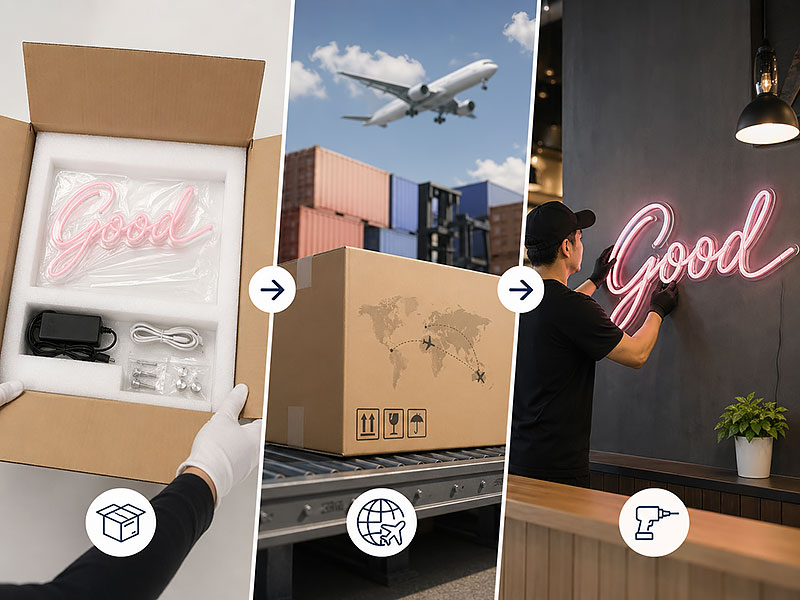
Order Confirmation
Order confirmation is the first real production step. Before the factory makes the sign, both sides should agree on the final design, size, color, usage environment, backing material, power plug, control method, packaging, and installation accessories.
For a simple indoor slogan sign, this may take only a short conversation. For a large logo sign, outdoor storefront sign, chain-store order, or event project, confirmation should be more detailed.
A good order confirmation should include:
| Detail | Example |
|---|---|
| Sign text or logo | “Open”, brand logo, slogan, icon |
| Final size | 80 cm wide, 120 cm wide, or custom wall size |
| LED color | Warm white, cool white, red, pink, RGB, brand color |
| Backing type | Clear acrylic, black acrylic, cut-to-shape acrylic |
| Use environment | Indoor, semi-outdoor, outdoor |
| Plug type | US, UK, EU, AU, or other |
| Control method | On/off switch, dimmer, remote, RGB controller |
| Wire exit | Bottom right, bottom left, back center, hidden wire |
| Installation | Wall-mounted, hanging, stand-off screws, frame |
| Packaging | Standard carton, reinforced carton, wooden crate |
This step prevents most common problems. If the sign is used in the United States but the plug type is not confirmed, the adapter may be wrong. If the sign is for a restaurant patio but the use environment is not mentioned, the factory may produce an indoor version. If the wire exit is not marked, the finished sign may have a cable in the most visible place.
For sign companies, resellers, and chain-store projects, order confirmation should be saved as a reference for future repeat orders. Once the first order is approved, the same specification can be reused later instead of starting from zero.
Artwork Files
Good artwork makes production faster and more accurate. The best file is usually a vector file, such as AI, EPS, SVG, or editable PDF. Vector files allow the factory to scale the logo without losing edge quality, which is important for neon tube layout and acrylic cutting.
If you do not have a vector file, a high-resolution PNG or JPG can still be useful, but the factory may need extra time to redraw or adjust the artwork. For a simple text sign, you can provide the wording, font reference, color, and preferred style. For a logo sign, the clearer the file, the better the final result.
Useful files include:
| File Type | Best Use |
|---|---|
| AI / EPS / SVG | Best for logo accuracy and production drawing |
| Editable PDF | Useful for brand logos and text layouts |
| High-resolution PNG | Good backup if vector file is unavailable |
| JPG reference | Useful for style direction |
| Wall photo | Helps judge size and placement |
| Hand sketch | Good for rough ideas before mockup |
| Brand guideline | Useful for chain stores and corporate projects |
Do not worry if the artwork is not perfect at the beginning. A professional factory can help turn a logo, sketch, reference image, or simple idea into a production-ready layout. This is especially useful for restaurants, cafés, salons, gyms, event planners, and small businesses that know the look they want but do not have technical sign drawings.
For commercial projects, one important point is readability. A logo that looks clear on a phone screen may not work well as LED neon if the lines are too thin or the letters are too close. The factory should review the artwork and suggest adjustments before production.
Design Mockup
The design mockup is where the idea becomes visible. It helps check the sign shape, size ratio, color direction, backing shape, wire position, and general look before production starts.
A good mockup should not only look beautiful. It should help answer practical questions:
| Mockup Detail | What It Helps Confirm |
|---|---|
| Letter thickness | Whether the neon tube can bend properly |
| Logo layout | Whether the design is readable |
| Backing shape | Whether the sign looks clean when turned off |
| Wire exit | Whether installation will look tidy |
| Size ratio | Whether the sign fits the wall or display area |
| Color choice | Whether the sign matches the brand mood |
| Mounting holes | Whether installation will be simple |
A script font may need slightly thicker strokes. A detailed logo may need simplification. A long slogan may need two lines instead of one. A small sign may need a bolder font to stay readable. These are not design failures. They are normal adjustments when turning digital artwork into a physical illuminated sign.
For international projects, mockups also reduce communication risk. The project owner, factory, interior designer, installer, and final client can all review the same visual reference. This is very useful for sign companies, design studios, and chain brands because it prevents different people from imagining different results.
Production Time
Production time depends on sign size, design complexity, material availability, quantity, and whether the product needs special processes. A simple indoor LED neon sign is usually much faster than a large outdoor logo sign or a mixed-material sign with acrylic, metal, channel letters, and waterproof treatment.
A practical production timeline may look like this:
| Stage | Typical Focus |
|---|---|
| Day 1 | Requirement confirmation and artwork review |
| Day 1–2 | Mockup, quotation, and production details |
| Day 2–3 | Material preparation and layout confirmation |
| Day 3–6 | Tube bending, acrylic cutting, wiring, assembly |
| Day 6–7 | Testing, quality inspection, packing |
| Extra time | Special molds, outdoor structure, or bulk orders |
The exact time should always be confirmed before the order starts. A small one-piece sign and a batch of 50 chain-store signs cannot follow the same timeline.
For store openings, exhibitions, weddings, seasonal campaigns, and retail launches, do not plan only around production time. Shipping, customs, local delivery, and installation also take time. A sign produced in 7 days is not useful if it arrives after the event date.
A safe project plan should work backward from the final installation date. Leave time for design approval, production, shipping, customs, local delivery, installation, and possible adjustment.
Production Process
The production process of a custom LED neon sign usually includes artwork conversion, acrylic cutting, neon tube bending, LED assembly, wiring, power matching, mounting hole preparation, cleaning, testing, and packing.
The exact process depends on the sign type. A simple wall sign may be made with LED neon flex mounted on clear acrylic. A more premium sign may use cut-to-shape acrylic, metal details, printed parts, or combined lighting. A large outdoor sign may require stronger sealing and more careful wiring.
A simplified production flow:
| Production Step | What Happens |
|---|---|
| Artwork conversion | Logo or text is turned into a production drawing |
| Backing cutting | Acrylic or other backing is cut to shape |
| Tube bending | LED neon flex is shaped according to the design |
| Fixing and assembly | Neon tube is fixed onto the backing |
| Wiring | Cable, adapter, dimmer, or controller is connected |
| Hole preparation | Mounting holes or hanging points are prepared |
| Cleaning | Surface, acrylic, and edges are checked |
| Lighting test | Sign is turned on and tested |
| Final inspection | Appearance, accessories, and packing are confirmed |
The quality of the production process can often be seen in small details. Are the bends smooth? Are the letters evenly spaced? Is the backing clean? Are there glue marks? Is the wire route tidy? Does the sign look acceptable when turned off? These details matter because commercial signs are viewed up close in real spaces.
A good manufacturer should not rush these steps just to ship faster. Speed is useful, but only if the sign is still accurate, clean, and safe.
Quality Testing
Quality testing should happen before the sign is packed. For international orders, this is especially important because finding a problem after delivery is much more expensive and time-consuming.
A reliable factory should test the sign as a finished product, not just as separate parts. The sign should be turned on, checked for even brightness, tested with the dimmer or remote if included, and inspected for surface damage or wiring problems.
A practical testing checklist:
| Test Item | What to Check |
|---|---|
| Lighting | No dark spots, no flicker, no weak sections |
| Color | Matches approved color or RGB function works |
| Brightness | Suitable and stable |
| Dimmer | Brightness adjusts smoothly |
| Remote | Responds correctly |
| Adapter | Correct plug and stable output |
| Wiring | No loose connection |
| Acrylic | No cracks, deep scratches, or dirty marks |
| Mounting holes | Correct position and clean cutting |
| Accessories | Screws, spacers, chains, or brackets included |
For commercial signs, an aging or continuous lighting test is useful. Even a short lighting test can reveal unstable wiring, heat issues, flicker, or weak LED sections. This is especially important for restaurants, bars, gyms, offices, and retail stores where signs may run 8–12 hours per day.
Before shipping, ask for photos and videos. A good video should show the full sign turned on, close-up details, and the control function if the sign includes a dimmer, remote, or RGB mode.
Export Packaging
Packaging is not just a shipping detail. It is part of product quality. A sign can be produced perfectly but still arrive damaged if the packaging is weak.
LED neon signs are often mounted on acrylic. Acrylic looks clean and modern, but it can crack under pressure, especially at corners or screw holes. Neon tube sections can also be damaged if heavy pressure is placed on the package. Accessories can scratch the sign if they are not packed separately.
Good export packaging should protect against pressure, vibration, corner impact, surface scratches, and internal movement.
| Packaging Detail | Why It Matters |
|---|---|
| Protective film | Prevents acrylic scratches |
| Foam layer | Absorbs vibration and pressure |
| Corner protection | Reduces cracking risk |
| Separate accessory bag | Prevents screws from scratching the sign |
| Cable protection | Avoids pulling or bending damage |
| Strong carton | Handles courier movement better |
| Wooden crate | Useful for large or high-value signs |
| Outer label | Helps warehouse and installer identify contents |
For small indoor signs, foam and a strong carton may be enough. For large signs, irregular shapes, expensive logo signs, or bulk shipments, reinforced cartons or wooden crates may be safer.
For resellers, packaging also affects customer experience. A clean package, neat accessory bag, and simple instruction sheet make the product feel more professional. For event companies, reusable packaging can help protect the sign between different projects.
Shipping Method
Shipping method should be chosen based on order size, deadline, budget, and damage risk. There is no single best shipping method for every order.
Common shipping options include courier, air freight, sea freight, and buyer’s forwarder.
| Shipping Method | Best For | Main Advantage | Main Limitation |
|---|---|---|---|
| Express courier | Samples, small signs, urgent orders | Fast and door-to-door | Higher cost for large signs |
| Air freight | Medium urgent orders | Faster than sea freight | More expensive than sea |
| Sea freight | Bulk orders, large signs | Lower cost per unit | Longer transit time |
| Buyer’s forwarder | Experienced importers | More control over logistics | Buyer manages more details |
For one sample sign, courier is often the easiest option. For a batch of signs, air or sea shipping may be more cost-effective. For large acrylic signs, shipping cost can increase quickly because carriers calculate by size and volume, not only weight.
Ask whether the quote includes shipping or only factory price. Many misunderstandings happen because the product price looks low, but shipping is calculated later.
A clearer quotation should separate:
- Product cost
- Packaging cost if special packing is needed
- Shipping method
- Estimated shipping cost
- Destination country
- Delivery terms
- Possible customs duties or import taxes
The factory can help with shipping arrangements, but you should also understand local import rules in your own country. Customs duties, VAT, local tax, or clearance fees may not be included in the factory quotation.
Customs and Import
Customs is often ignored until the shipment arrives. For international projects, especially first-time imports, it is important to understand that product cost and shipping cost are not always the final landed cost.
Depending on the destination country, the receiver may need to pay import duty, VAT, customs clearance fees, local delivery charges, or broker service fees. These charges vary by country and shipping method.
Before shipping, confirm:
| Customs Detail | Why It Matters |
|---|---|
| Product description | Helps customs classify the product |
| Commercial invoice | Needed for clearance |
| Declared value | Affects duty and tax calculation |
| HS code | Used for customs classification |
| Destination contact | Needed for delivery and clearance |
| Importer information | Important for business orders |
| Local tax responsibility | Avoids surprise cost after arrival |
For small courier shipments, the courier company may contact the receiver when tax or duty is due. For sea freight or larger shipments, a customs broker or forwarder may be needed.
A good manufacturer can prepare basic export documents, but local import requirements should still be checked. This is especially important for sign companies and resellers that import regularly.
Installation Planning
Installation should be discussed before production because installation details affect backing shape, hole position, wire exit, cable length, accessories, and packaging.
A small indoor LED neon sign may be easy to install with screws or hanging chains. A large office logo sign may need stand-off screws and hidden wiring. An outdoor storefront sign may need a local electrician and stronger brackets. An event sign may need a portable frame or hanging structure.
Common installation methods include:
| Installation Method | Best Use |
|---|---|
| Pre-drilled holes | Standard wall-mounted signs |
| Stand-off screws | Premium office, retail, and reception walls |
| Hanging chain | Windows, events, temporary displays |
| Wall hooks | Lightweight indoor signs |
| Back frame | Larger signs or repeated event use |
| Brackets | Outdoor or heavier signs |
| Hidden wiring | High-end interior walls |
| Plug-and-play cable | Events and simple indoor use |
Before production, answer these questions:
- Will the sign be mounted on a wall, window, frame, or stand?
- Is the wall concrete, drywall, wood, glass, tile, or metal?
- Where is the nearest power outlet?
- Should the wire be visible or hidden?
- Does the sign need to be removed often?
- Will a local installer handle the job?
- Does the sign need an installation template?
For chain-store projects, installation templates are very useful. They help different stores install the sign at the same height and position, keeping the brand look consistent.
Installation Accessories
A custom LED neon sign should arrive with the right accessories. Missing or unsuitable accessories can delay installation, especially when matching parts are not easy to find locally.
Basic accessories may include screws, wall anchors, spacers, hanging chains, hooks, power adapter, dimmer, remote, controller, and instruction sheet. The exact kit depends on the sign structure.
| Accessory | Why It Matters |
|---|---|
| Screws | Fix the sign to the wall |
| Wall anchors | Help with drywall or masonry surfaces |
| Spacers | Create a clean floating effect |
| Hanging chain | Useful for windows and events |
| Hooks | Simple hanging installation |
| Power adapter | Matches the LED system |
| Dimmer | Controls brightness |
| Remote | Useful for high or event signs |
| RGB controller | Controls color-changing signs |
| Installation guide | Reduces confusion on site |
For premium office or retail signs, stand-off screws can make the sign look cleaner and more professional. For events, hanging chains and quick setup hardware may be more practical. For outdoor signs, accessories should match the weight and installation environment.
Do not assume the factory will automatically include everything you need. Ask what accessories are included in the quotation.
Wire Position
Wire position is one of the most important small details. If it is wrong, the sign may still work, but the final installation may look messy.
A wire exiting from the bottom left may be fine if the outlet is nearby. But if the outlet is on the right side, the cable may cross the wall. For reception walls, hidden wiring is often preferred. For event signs, visible cable may be acceptable if setup speed is more important.
Common wire exit options:
| Wire Exit Position | Best For |
|---|---|
| Bottom right | Common wall installation with outlet nearby |
| Bottom left | Useful when power source is on the left |
| Back center | Better for hidden wiring |
| Top side | Sometimes used for hanging signs |
| Longer cable | Useful for events and flexible placement |
| Split wiring | Used for large or multi-part signs |
Wire position should be marked on the production drawing. This is a small step, but it prevents a very visible problem.
For chain stores, keeping the same wire position across all signs can make local installation easier and more consistent.
After Delivery
When the sign arrives, inspect it before installation. Do not throw away the packaging immediately. If there is shipping damage, the packaging may be needed for a claim.
After delivery, check:
| Check Item | What to Do |
|---|---|
| Outer carton | Look for dents, holes, water marks, or crushing |
| Acrylic | Check cracks, scratches, and corners |
| Neon tube | Check loose sections or pressure marks |
| Accessories | Confirm screws, adapter, remote, and dimmer |
| Plug type | Make sure it matches your market |
| Lighting | Test before mounting |
| Remote/dimmer | Test all control functions |
| Wire | Check connection and cable position |
Test the sign on a safe surface before installing it. Turn it on, check brightness, test controls, and confirm that all parts are working.
If there is a problem, take clear photos and videos immediately. Show the outer carton, inner packaging, damaged area, and lighting issue. This helps the manufacturer understand whether the issue came from production, shipping, or handling.
Maintenance
LED neon signs are usually easy to maintain, but commercial spaces still need basic care. Dust, moisture, rough handling, and poor power connection can shorten product life.
For indoor signs, regular cleaning with a soft dry cloth is usually enough. Avoid harsh chemicals, heavy pressure, or pulling on the neon tube. For signs installed in restaurants, bars, salons, or gyms, cleaning may be needed more often because of dust, smoke, humidity, or fingerprints.
Basic maintenance advice:
| Maintenance Point | Recommended Practice |
|---|---|
| Cleaning | Use soft dry cloth or gentle cleaning method |
| Power | Turn off before cleaning |
| Cable | Do not pull or sharply bend wires |
| Adapter | Keep in a dry and ventilated position |
| Outdoor signs | Check seals and wiring regularly |
| Event signs | Repack carefully after each use |
| Storage | Keep flat or protected, avoid pressure |
For event planners, storage is especially important. A sign used for weddings, exhibitions, or parties may be installed and removed many times. Keep the original foam, carton, or custom packaging if the sign will be reused.
For chain stores, keep spare adapters or controllers if the signs are important for daily business. A spare part is a small cost compared with downtime.
Project Timeline
A realistic project timeline helps avoid stress. Many people only ask about production time, but the full timeline includes design, approval, production, testing, packing, shipping, customs, local delivery, and installation.
A simple project may look like this:
| Stage | Estimated Time |
|---|---|
| Requirement discussion | 1–2 days |
| Design mockup and confirmation | 1–3 days |
| Sample production | Depends on design and factory schedule |
| Quality check and packing | Around 1 day |
| Express shipping | Several days depending on country |
| Air or sea freight | Depends on destination and shipping method |
| Local installation | Usually 1 day for simple signs |
For urgent projects, the biggest risk is not always production. It may be design approval, customs, local delivery, or missing installation details.
For store openings, exhibitions, and events, set the final installation date first, then plan backward. A sign should ideally arrive with enough time for inspection and installation, not on the last possible day.
A good manufacturer can help speed up the process, but the project side also plays a role. Fast artwork approval, clear requirements, correct address information, and timely payment all help avoid delays.
Common Mistakes
Many production and shipping problems come from small details that were not confirmed early. These mistakes are easy to avoid if the project details are clear before production.
Common mistakes include:
| Mistake | Result |
|---|---|
| Only sending a logo without size | Wrong scale or unreadable design |
| Not confirming indoor or outdoor use | Wrong material or waterproof level |
| Ignoring wire exit position | Messy installation |
| Choosing RGB for strict brand color | Color inconsistency |
| Not checking plug type | Adapter may not fit local market |
| Choosing weak packaging to save cost | Higher damage risk |
| Not asking for pre-shipment video | Problems found after delivery |
| Planning shipping too late | Missed opening or event date |
| Throwing away packaging immediately | Harder to claim shipping damage |
| Installing without testing first | More difficult troubleshooting |
The best way to avoid these mistakes is simple: confirm more before production, not after delivery.
A custom LED neon sign should be treated like a small commercial project, not just a decorative product. When design, production, shipping, and installation are planned together, the final sign is easier to install, safer to use, better-looking in the real space, and more reliable for long-term business use.
Final Thoughts: A Good LED Neon Sign Starts Before Production
A custom LED neon sign is easy to enjoy after it is installed, but the real success is decided before production begins. The design must match the space, the material must match the use environment, the brightness must match the mood, and the packaging must protect the sign during international shipping.
The smartest decision is not always choosing the cheapest sign or the most complicated design. It is choosing a sign that fits the project and a manufacturer that can explain the production logic behind it. A restaurant needs visual attraction, a salon needs photo-friendly lighting, a sign company needs stable supply, an event planner needs fast setup and reuse, and a chain-store team needs consistency.
If you are planning a custom LED neon sign for a restaurant, café, bar, salon, gym, retail store, office, event, sign company, interior design project, or chain-store rollout, you can send your logo, text, size, wall photo, reference image, or project idea to Iduoduo for a clear production plan and quotation.