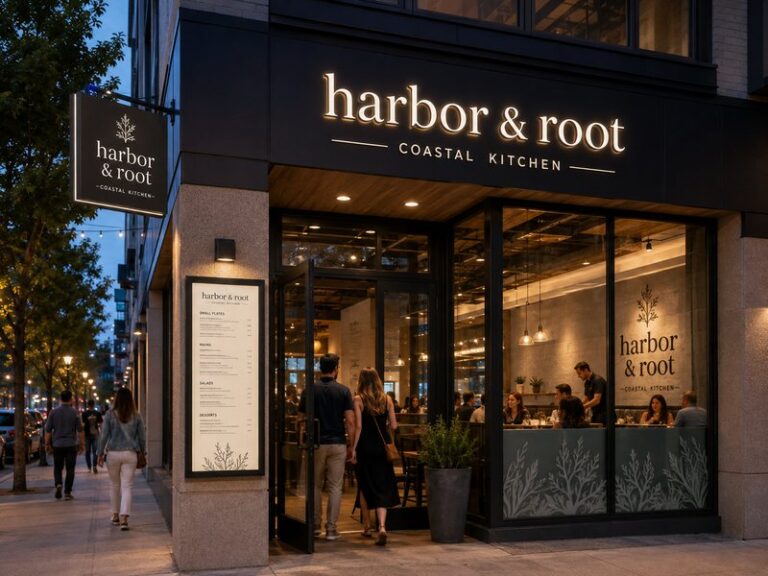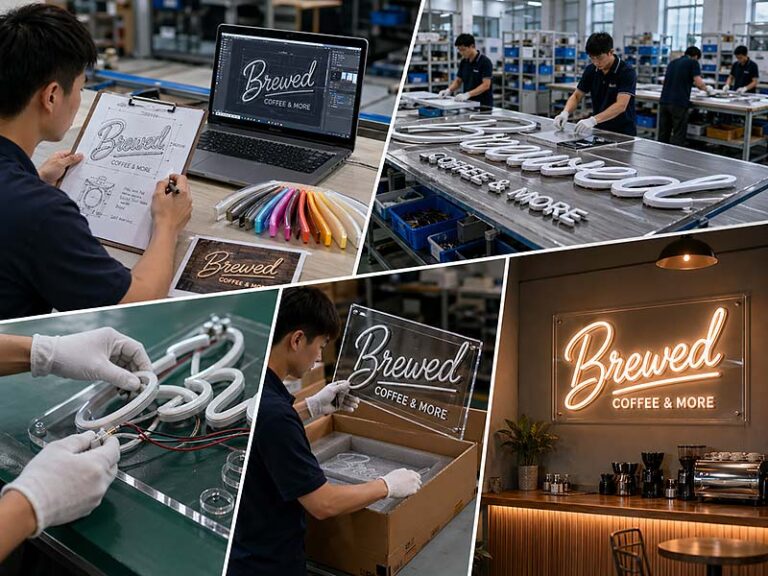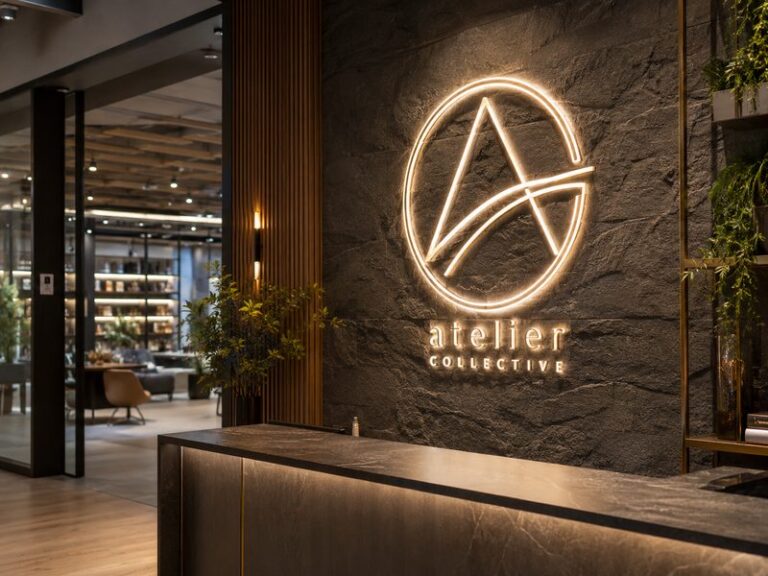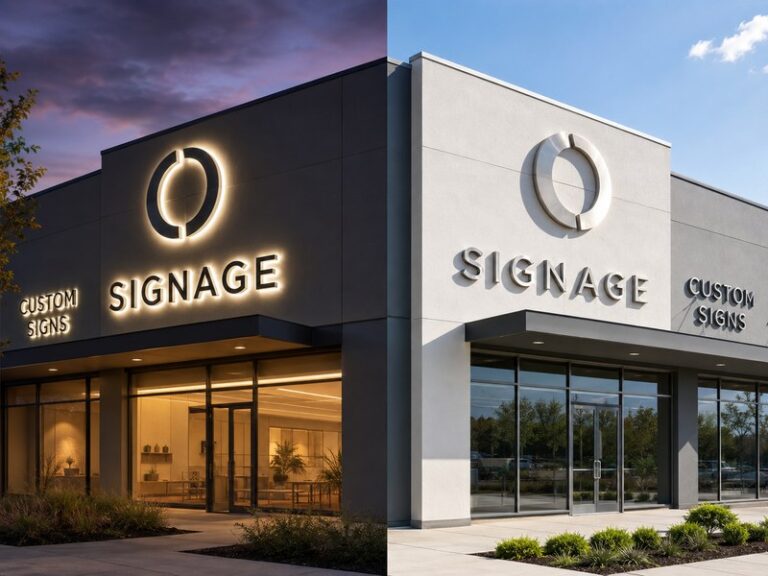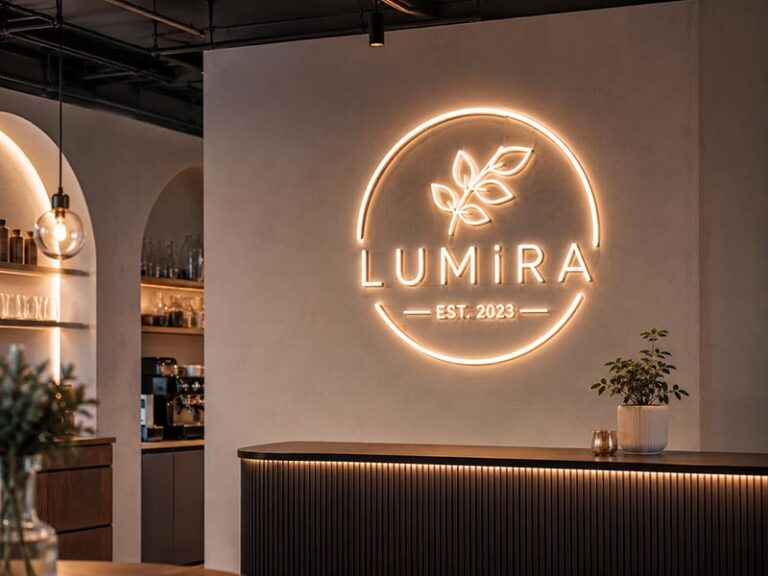

An LED neon sign can look almost effortless once it is glowing above a storefront, restaurant terrace or outdoor entrance, but the engineering behind a reliable exterior installation is more complicated than the illuminated line suggests. Rain rarely attacks only the visible Neon Flex. Moisture can travel through a connector, cable exit, mounting hole or wall penetration. Direct sun heats the backing and electrical components, while humidity, temperature changes and coastal air can slowly affect seals, fasteners and connections. That is why the useful question is not simply whether LED neon can be placed outdoors, but whether the entire sign system was designed for the environment where it will spend the next several years.
Yes, LED neon signs can be used outdoors when they are specifically engineered for exterior exposure. A dependable outdoor system should combine suitable Neon Flex, protected connectors and wire exits, an appropriate power supply, weather-resistant backing and mounting, effective sealing and drainage, and an installation plan that accounts for rain, UV exposure, humidity, temperature changes and local environmental conditions.
Two identical-looking logo signs can therefore require very different specifications. One may spend its life behind a reception desk at a stable indoor temperature, while the other sits on a west-facing café wall that receives afternoon sun, wind-driven rain and large seasonal temperature changes. Their artwork can be identical, but the construction behind that artwork should not be. Understanding those differences before production is what turns an attractive LED neon sign into a reliable outdoor sign.
Can LED Neon Signs Be Used Outdoors?

Yes. LED neon can be used outdoors when the complete sign is developed for exterior exposure rather than simply moved outside after being designed for indoor use. Outdoor performance depends on the Neon Flex, connections, power system, backing, mounting points, cable exits, sealing and drainage. A normal indoor sign should not be assumed suitable for permanent rain, humidity or direct weather exposure.
Are All LED Neon Signs Weatherproof?
Not every LED neon sign is weatherproof. LED technology itself does not automatically make a finished sign suitable for rain, humidity, sunlight or repeated outdoor temperature changes. A typical sign combines flexible illuminated material, backing, wiring, a power supply and installation hardware. Each of those elements can behave differently outdoors, which means the environmental specification has to cover the complete assembly rather than only the visible illuminated portion.
This distinction is easy to miss because indoor and outdoor versions can look almost identical in photographs. The important differences are often hidden around cut ends, connectors, cable entries, mounting holes and electrical components. An office-wall logo may never encounter direct moisture, while the same design on a restaurant façade can face rain, washing water, condensation and strong solar heating. Outdoor engineering therefore starts with the actual installation environment rather than with the visual design alone.
A practical evaluation should answer several questions before production:
- Is the Neon Flex specified for outdoor use?
- How are cut ends and electrical joints protected?
- Where does the cable leave the sign?
- Will the power supply remain indoors or outdoors?
- Can water collect behind the backing?
- Is the wall sheltered or fully exposed?
- Will the sign face strong sun, freezing temperatures or coastal air?
- Who will seal the wall penetration during installation?
A sign becomes genuinely outdoor-ready when these details are considered together. Calling one component waterproof is not enough if the electrical connection or installation interface remains exposed.
What Makes LED Neon Outdoor-Rated?
An outdoor-rated LED neon sign is usually defined by a series of small engineering decisions rather than one dramatic design change. The Neon Flex should match the expected exposure, while cut points, end seals and connectors need protection appropriate to the project. Cable exits should be positioned so that water is not encouraged to run toward electrical joints, and the backing should remain stable under UV exposure, temperature movement and normal outdoor cleaning.
The power system is equally important. Depending on the project, the power supply may be positioned indoors, inside a protected service area or in an outdoor location using a suitable enclosure or outdoor-rated component. Controls such as dimmers, RGB controllers and remote-control receivers also need separate consideration because they may not have the same environmental protection as the sign body. Treating every connected component as if it shared one IP rating creates avoidable risk.
Outdoor construction should also consider water movement rather than relying only on sealant. The design needs to ask where rain first lands, whether water can move behind the backing, whether moisture can remain around a low point and whether condensation has a safe path to escape. For iduoduo outdoor LED neon projects, this broader approach includes Neon Flex, connectors, wire exits, power, backing, fixing, sealing, drainage, UV exposure and installation waterproofing as parts of the same system.
Can Indoor LED Neon Be Used Outside Temporarily?
An indoor LED neon sign may sometimes be used outdoors for a short period when the environment remains dry, sheltered and controlled, but temporary use should not be confused with permanent outdoor suitability. A sign placed under a fully covered event canopy for several hours experiences a very different risk from the same product left overnight on an uncovered patio where humidity, condensation or unexpected rain may reach electrical parts.
Temporary outdoor use should therefore be treated as an exception rather than as proof that an indoor product is weatherproof. The power adapter must remain protected, the sign should not be exposed to rain or cleaning water, and the event team should be able to remove the product quickly if conditions change. Overnight use is more demanding because falling temperatures can create condensation even when there has been no rainfall.
| Use Condition | Indoor Version | Outdoor Version |
| Dry indoor wall | Suitable | Suitable |
| Short covered event | Possible with protection | Suitable |
| Covered outdoor terrace | Limited, project-dependent | Preferred |
| Exposed storefront | Not recommended | Required |
| High-humidity exterior | Not recommended | Outdoor specification required |
| Coastal exterior | Not recommended | Project-specific outdoor version |
For permanent commercial branding, specifying the correct outdoor version before production is generally more economical than trying to retrofit waterproofing later. Exterior exposure is cumulative, and surviving the first shower does not demonstrate reliable service through repeated seasons of rain, sunlight and temperature movement.
Which IP Rating Is Right for Outdoor LED Neon?

The appropriate IP rating depends on the real exposure rather than the simple label “outdoor.” Normal exterior projects can often be developed around IP65, while higher-rain, high-humidity or more demanding exposure may justify IP67. IP68 can be considered on request for applications that genuinely require it. The rating should always be reviewed together with connectors, power, sealing, drainage, mounting and installation conditions.
What Does IP65 Protect Against?
IP ratings provide a structured way to describe protection against solid particles and water, but the number should not be treated as a complete prediction of outdoor service life. For LED neon projects, IP65 is commonly associated with conventional exterior applications where strong protection from dust and rain or water jets is required but where the product is not intended to remain submerged in water.
That can make an IP65 configuration suitable for many storefront walls, covered commercial entrances, restaurant exteriors and similar locations. However, the specification still needs to identify which part of the finished system carries that protection. The Neon Flex may have one rating while a separate adapter, dimmer, controller or field connector has another. A wall penetration completed by the local installer is also outside the factory’s product enclosure.
Exposure should therefore be reviewed alongside the rating. An IP65 sign positioned beneath a deep canopy experiences a different level of water pressure and solar heating from the same sign mounted on an exposed upper façade. Wind-driven rain, cleaning methods, cable orientation and drainage can all change the real operating conditions. Good specification work uses the IP rating as one part of the decision, not as a substitute for understanding the installation.
When Is IP67 a Better Choice?
IP67 is often considered when the project faces heavier rain, persistent humidity or a level of water exposure beyond a conventional sheltered exterior. The decision is particularly relevant for open façades, high-rainfall environments and locations where moisture is likely to remain around connectors or exposed surfaces for longer periods. In these situations, stronger protection can reduce risk, provided the installation and associated electrical components are planned to the same standard.
The exact position of the sign often matters more than the city printed on the delivery address. A recessed sign under a deep canopy may remain relatively protected even in a rainy climate, while a rooftop logo in the same city can be fully exposed to wind-driven water from several directions. Environmental classification should therefore be based on the installation point, not only on regional weather statistics.
| Installation Condition | Typical Specification Direction | Main Items to Review |
| Indoor commercial wall | Indoor version | Appearance, wiring, glare |
| Covered exterior | IP65 may be suitable | Cable exits, power position |
| Exposed storefront | IP65 or IP67 | Rain path, sealing, drainage |
| Heavy-rain location | IP67 preferred | Connectors, wire exits, backing |
| High-humidity location | IP67 preferred | Condensation, power, ventilation |
| Coastal location | Project-specific outdoor version | Corrosion, hardware, connectors |
| Specialist high-exposure use | Engineering review | Full electrical and structural system |
For iduoduo projects, the general outdoor language separates normal IP65 applications from higher-rain or high-humidity IP67 applications. This distinction creates a more useful specification than presenting every exterior sign as if it required the maximum possible level of waterproofing.
Is IP68 Always Necessary?
IP68 is not automatically necessary simply because a sign is installed outdoors. Most commercial neon signs are designed to survive repeated exposure to rain, humidity, sunlight and temperature changes rather than continuous underwater operation. Selecting the highest available IP number without examining how the sign will actually be used can create a specification that sounds impressive but does not necessarily address the most likely causes of failure.
A very tightly sealed construction can also affect serviceability, connector access and heat management. Outdoor sign engineering therefore involves balancing protection with maintenance, drainage and practical installation. If the project is an exposed storefront in a rainy city, improved sealing and an appropriate IP67 configuration may be more relevant than demanding IP68 while leaving the power adapter or wall penetration poorly protected.
iduoduo uses the wording “IP68 available on request” rather than treating IP68 as a universal default. That approach encourages the project team to explain the actual exposure first. For normal commercial work, the more important question is whether every critical component has adequate protection for the environment, not whether the specification sheet displays the largest number.
How Should IP Ratings Be Evaluated?
An IP rating should be evaluated at system level. The first step is identifying exactly what carries the rating: the Neon Flex, an enclosure, the complete sign body or another component. The second step is mapping everything connected to that rated component, including power supplies, controllers, cables, field connectors and wall penetrations. A strong rating on the illuminated section cannot compensate for an unprotected connection elsewhere.
The installation environment should then be described in practical terms. Instead of simply stating “outdoor,” the project team should record whether the location is covered, partially exposed or fully exposed; whether heavy rain is common; whether cleaning water may reach the sign; whether the site is humid or coastal; and whether service components will be accessible after installation. These details provide a much better basis for selecting IP65, IP67 or a special higher-protection configuration.
Four questions are especially useful during specification:
- Which components carry the stated IP rating?
- Where will the power supply and controller be located?
- How will cable entries and wall penetrations be protected?
- What type of water exposure is expected during normal use?
A reliable outdoor system is created when the rating, construction and installation all support one another.
How Does Outdoor Weather Affect LED Neon?

Outdoor weather affects far more than water resistance. Rain challenges joints and cable entries, humidity can create condensation, sunlight heats the backing and polymer components, high temperatures accelerate electrical and material ageing, cold affects flexibility and sealing, and salt-laden coastal air increases corrosion. Outdoor specifications should therefore account for climate, orientation, operating hours and maintenance conditions before the final materials and electrical layout are approved.
How Do Rain and Humidity Affect the Sign?
Rain tends to find transitions and openings rather than passing directly through the middle of a well-manufactured continuous Neon Flex section. Cable exits, connector joints, end caps, drilled mounting holes and wall penetrations are therefore common areas requiring careful attention. Water can also follow a cable by gravity, which means even a small change in cable direction can influence whether moisture moves away from or toward an electrical connection.
Humidity creates a less visible challenge. Moist air can enter cavities or condense when temperatures change between day and night. A product may never experience obvious water penetration but can still accumulate internal moisture if the construction does not manage condensation properly. This is one reason outdoor design should balance sealing with drainage rather than assuming every cavity can remain permanently dry.
A useful water-path review considers where rain first lands, how it moves across the backing, whether it reaches the lower edge, where the cable leaves the product and whether any low point can trap moisture. It should also consider cleaning. Restaurant façades, shopfronts and public commercial areas may be washed or sprayed, creating exposure patterns different from ordinary rainfall.
How Does UV Exposure Affect Materials?
Sunlight can affect an outdoor LED neon sign even when rain never reaches it. Ultraviolet exposure and solar heating can gradually influence acrylic backing, polymers, cable insulation, adhesives, sealing compounds and surface finishes. Dark components may absorb additional heat, and a wall facing the afternoon sun can operate at a much higher surface temperature than the surrounding air temperature suggests.
The orientation of the sign therefore matters. A north-facing sign under a canopy may experience relatively mild solar stress, while a west-facing installation can receive several hours of intense afternoon sun every day. The materials, backing thickness, cable routing and power location should be selected with that exposure in mind, especially when the sign is intended to operate for several years rather than for a temporary campaign.
Outdoor durability also includes the appearance of the sign when it is switched off. A neon logo can continue illuminating correctly while its backing, cable or surface finish begins to age. Commercial signage is viewed during daylight as well as at night, so material stability and visual condition should be included in the quality discussion rather than focusing only on LED brightness.
How Do Heat and Cold Affect Components?
High temperatures can influence LEDs, power supplies, controllers, acrylic, PVC, adhesives, sealants, wires, coatings and films. Long-term thermal stress can accelerate LED light depreciation, change colour appearance, weaken adhesive systems and reduce the useful life of power components. Adding more LEDs to achieve greater daylight brightness can also increase heat, which is why optical performance and thermal management should be considered together.
Cold environments create a different group of problems. Low temperature can affect power-supply startup, cable flexibility, sealing compounds, adhesives and some plastic materials. When water enters a small gap and repeatedly freezes and thaws, the expansion can gradually enlarge cracks or damage seals. Outdoor construction for cold climates therefore needs attention to both water management and the minimum operating temperature of key components.
Large temperature swings also produce expansion and contraction. Acrylic, metals, plastics and sealants do not move at exactly the same rate, so large backings and long mounting runs should not be treated as perfectly rigid objects. Allowing the materials to behave normally under seasonal changes can help reduce cracking, warping and stress around mounting points.
How Do Coastal Conditions Change the Specification?
Coastal air introduces salt, which can accelerate corrosion on metal brackets, screws, terminals, connectors and damaged surface coatings. The visible Neon Flex may continue to look normal while mechanical fasteners or electrical interfaces slowly deteriorate. A coastal installation therefore deserves a different review from an ordinary inland exterior, especially when the site is close to the shoreline or regularly exposed to sea spray.
Material selection should focus on corrosion-resistant hardware, appropriate metal choices, protected connectors and good coating quality. Dissimilar metals also need attention because direct contact in a salty environment can increase galvanic corrosion. Power supplies and terminals should be positioned where salt and moisture are less likely to accumulate, and regular inspection becomes more valuable than it would be for a sheltered indoor sign.
iduoduo distinguishes Coastal Version from standard Indoor Version and Outdoor Version when project conditions require it. The visible logo and brand colours can remain consistent, while hidden choices such as hardware, protection, power configuration and maintenance recommendations change according to the environment. This approach is particularly useful for chains operating the same brand identity across inland, tropical and coastal locations.
What Parts Must Be Weatherproof Outdoors?

Outdoor LED neon reliability depends on the full exposed system, including Neon Flex, cut ends, connectors, wiring, power supplies, controllers, wire exits, backing, mounting hardware, seals and drainage. A waterproof illuminated profile cannot compensate for an exposed connector or poorly protected power component. Each element should be reviewed according to its position and the amount of rain, humidity, UV exposure and temperature change it will experience.
Is the Neon Flex Waterproof?
The Neon Flex is the most visible part of the product and usually receives the most attention, but its long continuous sections are often easier to protect than the locations where they end or connect to wiring. Cut points, end seals, connector positions and cable transitions create changes in material and geometry, which means these details deserve careful treatment in any serious outdoor design.
Complex logos can increase the number of difficult transitions. A simple word mark with long sweeping lines may require fewer connection points than a dense graphic containing many short strokes and tight corners. When artwork is too small for the practical bending radius or connector layout, enlarging the logo or simplifying tiny details can produce a more dependable result without noticeably changing the intended appearance.
This is why iduoduo develops LED neon through line-path engineering, Neon Flex selection, backing design, power matching, wire-exit planning and mounting preparation as one connected process. Outdoor protection begins with the lighting material, but reliable performance comes from the relationship between that material and every connection around it.
Is the Power Supply Outdoor-Rated?
The power supply is one of the most important parts of an outdoor LED neon installation because it connects the building’s electrical system to the low-voltage sign. Its position should be planned before production rather than decided casually after the sign arrives. When practical, placing the power supply in a dry and accessible interior or protected service space can reduce environmental stress and make future replacement easier.
When an outdoor location is unavoidable, the selected power supply and enclosure need to match the environmental conditions. The system should also provide reasonable capacity for the actual sign load. A power supply should not be chosen simply because it can illuminate the sign for a few minutes. Continuous operating load, cable length, voltage drop, heat dissipation and control equipment all influence reliable performance.
Destination-country voltage and local electrical requirements also matter. The same visible logo may require different plugs, power configurations or labels in the United States, United Kingdom, European Union or Australia. For international multi-store programmes, keeping the visual sign standard consistent while changing the electrical package for each market is usually more practical than forcing one electrical configuration into every location.
Are Controllers and Dimmers Waterproof?
Controllers, dimmers and remote-control receivers are frequently overlooked because they are smaller than the sign and often supplied as separate accessories. Their protection level should never be assumed to match the illuminated product automatically. An outdoor neon sign may have a suitable weather-resistant body while a standard dimmer or RGB controller remains vulnerable if it is mounted outside without additional protection.
The safest approach is to decide where each control component will be located before the wiring plan is finalised. Indoor placement is often preferable when the cable route allows it. When controls must remain outdoors, they need a suitable protected position or enclosure, along with enough access for future troubleshooting or replacement. Hiding every component permanently inside a sealed cavity can make later maintenance unnecessarily difficult.
RGB and RGBW systems deserve particular attention because they add additional wiring and control electronics compared with a simple single-colour sign. More components do not necessarily mean an unreliable system, but they do increase the number of interfaces that should be checked during production and installation. A clear electrical diagram is valuable for both factory testing and later service.
How Should Connectors and Wire Exits Be Protected?
Connectors and wire exits are small details with a large influence on outdoor reliability. Water can travel along a cable toward a connection, collect around an upward-facing exit or reach a wall penetration that was never intended to remain open. Cable direction, sealing location and physical support should therefore be determined during design rather than improvised on the installation day.
The backing also forms part of this system. It provides structural support, carries mounting holes and controls the relationship between the Neon Flex and the wall. Large acrylic sections need consideration for thermal movement, while exposed hardware should suit the local environment. In coastal or humid locations, corrosion-resistant fasteners and carefully protected interfaces become increasingly important.
The complete protection path should be easy to trace: Neon Flex protects the illuminated portion, end seals protect cut areas, connectors protect transitions, wire exits direct cables safely, backing supports the assembly, fixings hold it to the wall, site sealing protects the building penetration and drainage prevents moisture from remaining trapped. When every stage is clear, outdoor performance becomes much easier to evaluate.
How Should Outdoor LED Neon Be Installed?

Outdoor LED neon should be installed according to the real wall, product size, weather exposure and electrical layout. Correct installation keeps the sign mechanically secure while preserving the water protection created during manufacturing. Factory sealing cannot compensate for poorly sealed wall holes, unsuitable anchors, exposed power components or incorrect cable routing, so mounting, wiring, drainage and service access should be considered before production begins.
Which Mounting Method Fits the Site?
There is no universal mounting method for every LED neon sign. Smaller acrylic-backed products may use screws, stand-offs or prepared mounting holes, while larger signs may need additional fixing points, thicker backing or segmented construction. Suspended products introduce separate considerations such as hanging points, weight distribution and movement. The installation method should therefore follow the product and the site instead of forcing every design into one standard hardware package.
Wall material is equally important. Concrete, brick, timber, metal cladding, plasterboard and glass all create different fixing requirements. A manufacturer can prepare hole locations and installation templates, but the final anchors need to suit the actual substrate. For exterior projects, local installers also need to consider wind exposure, installation height and the consequences of water entering around drilled points.
Useful project information includes full wall photographs, wall material, available mounting area, target sign dimensions, installation height, weather exposure, power location, cable direction and access behind the wall. iduoduo can use these details to prepare mounting holes, wire exits, templates and accessories around the approved project, reducing the amount of field modification required after delivery.
How Should Sealing Be Handled?
Factory sealing and site sealing are connected but separate parts of the installation. The manufacturer can protect relevant Neon Flex ends, connectors, product-side wire exits and assembly joints. The installer then has to preserve that protection when the cable passes into the building and when screws or anchors penetrate the wall. If the site interface is left open, a well-sealed sign can still become part of a larger water-entry problem.
The wall penetration is one of the most important details. Different wall systems require different sealing methods, and the local installer is usually best positioned to select products compatible with the building surface. Cable routes should also avoid creating a direct path where rainwater can travel toward an electrical connection. A simple downward loop or carefully positioned exit can sometimes improve water management substantially.
Sealant should be used as part of a considered design rather than as a universal repair material. Applying more sealant does not solve incorrect drainage, poor cable orientation or structural movement. Long-term outdoor reliability usually comes from reducing the opportunities for water to reach vulnerable locations in the first place.
How Should Drainage and Power Be Positioned?
Outdoor protection is not always about making every space perfectly airtight. Condensation and small amounts of moisture can still occur, especially in humid environments or where day and night temperatures change significantly. If a structure creates a low point where water remains trapped, the design may need drainage or another method of releasing moisture rather than additional sealing alone.
Power components should also be kept away from locations where water can collect or where heat cannot escape. A power supply hidden tightly behind a sun-heated backing may experience more thermal stress than the same component located in a ventilated and accessible service area. Maintenance access matters because even a high-quality electrical component may eventually require inspection or replacement.
The best layout creates a clear hierarchy: the illuminated sign occupies the visible exterior position, cables travel through controlled routes, electrical controls are placed in protected and serviceable locations, and any unavoidable moisture has a safe path away from sensitive components. Thinking through this arrangement before production makes the later installation simpler and easier to maintain.
What Site Information Is Needed?
A logo file and overall width are enough to begin a visual mock-up, but they are not enough to finalise a reliable outdoor LED neon specification. The factory needs enough information to understand the environment, electrical system and installation interface. Providing these details early improves quotation accuracy and reduces changes after production has already started.
A useful outdoor project package normally includes:
- Vector logo or high-quality artwork.
- Target overall size.
- Quantity.
- Installation-area photographs.
- Wall material.
- Covered, partially exposed or fully exposed location.
- Local climate or unusual environmental conditions.
- Available input voltage.
- Power-source location.
- Preferred cable route.
- Single colour, dimming, RGB or RGBW requirement.
- Destination country.
- Target installation date.
The destination country matters because the same sign can require different electrical configurations, plugs, labels or documentation. For multi-country brand projects, the exterior appearance can remain consistent while the hidden electrical package changes to suit the market. Supplying complete project information allows iduoduo to evaluate manufacturability, weather protection, power, mounting and packaging together instead of pricing only from a photograph.
How Do You Verify Outdoor LED Neon Quality?

Outdoor LED neon should be verified through visual, electrical, waterproofing and installation-related checks rather than a quick power-on test. iduoduo uses 100% lighting inspection and a 72-hour pre-shipment test for illuminated products, together with checks of wiring, power supplies, connectors, mounting preparation and relevant outdoor protection. The unified quality standard combines 72-hour pre-shipment testing with a three-year warranty under defined project conditions.
What Should Be Checked Before Shipment?
A sign can illuminate correctly and still contain a problem that will matter during installation. Pre-shipment inspection should therefore compare the finished product against the approved drawing, electrical specification and installation requirements. Dimensions, logo proportions, backing shape, surface condition and colour need to be checked before the product is packed, especially when the sign is part of a larger brand programme with repeat orders.
Electrical inspection should cover illumination, wiring, power and controls, while outdoor projects require additional attention to the protection details around connectors, wire exits and relevant sealing points. Mounting holes and accessories should also be verified because a missing bracket or incorrect hole position can delay an installation even when the sign itself works perfectly.
| Inspection Item | Practical Check | Main Purpose |
| Dimensions | Compare with approved drawing | Reduce mounting mismatch |
| Logo geometry | Check shape and spacing | Protect brand consistency |
| Illumination | 100% lighting inspection | Find dark or abnormal areas |
| Power supply | Verify model and operation | Reduce electrical mismatch |
| Wiring | Inspect connections and polarity | Reduce intermittent faults |
| Connectors | Check assembly and protection | Improve outdoor reliability |
| Wire exits | Verify position and sealing | Reduce water-entry paths |
| Mounting holes | Compare with installation layout | Simplify site work |
| Outdoor structure | Review sealing and drainage | Manage moisture risk |
| Accessories | Count required parts | Prevent installation delays |
| Extended test | Run 72-hour test | Detect early electrical faults |
For repeat orders, inspection records become even more valuable. Saving drawings, component information and approved samples helps future batches reproduce the same visual and technical standard instead of relying on memory or photographs from previous projects.
How Does a 72-Hour Test Reduce Risk?
A short lighting check confirms that the product operates at one moment in time, while a 72-hour pre-shipment test gives the electrical system more opportunity to reveal unstable behaviour. iduoduo uses this period to observe LED stability, power-supply performance, control functions, flicker, early failures, local dark areas, colour stability, abnormal temperature rise and wiring connections before the product is packed for international shipment.
The purpose of this test is not to claim that the sign can never fail. Its value is to identify defects that may not appear during the first few minutes of operation. If an abnormal component or connection is detected, it can be repaired or replaced and then verified again before the sign leaves the factory.
This matters particularly for overseas projects because the cost of field failure extends far beyond the value of the faulty part. A small power component may cost relatively little, but replacing it after installation can involve an electrician, access equipment, store scheduling, removal, reinstallation and international replacement freight. Catching an early fault during factory testing can therefore prevent a much larger service cost.
How Should Outdoor Signs Be Maintained?
Outdoor LED neon generally does not require complicated daily maintenance, but periodic visual inspection can help identify developing problems before they affect the whole sign. Commercial installations should occasionally be checked after severe weather, building maintenance or cleaning work, particularly when the sign is mounted in a difficult-to-access position where a later service call could become expensive.
Useful maintenance checks include mounting stability, cable position, connector condition, visible sealing, corrosion around screws, unusual flicker, local dim areas, water accumulation and abnormal power-supply heat. Coastal and high-humidity locations usually deserve closer observation because salt and moisture can accelerate deterioration of exposed metal and electrical interfaces.
Cleaning should also be appropriate to the construction. High-pressure water directed at connectors, cable entries or wall penetrations can create exposure beyond normal rainfall. Maintenance teams should know where electrical components are located and avoid treating an outdoor sign as if every connected component could be pressure-washed without restriction.
What Affects Outdoor Service Life?
Outdoor service life is influenced by more than the nominal life of the LED source. Operating temperature, daily lighting hours, power-supply quality, electrical loading, UV exposure, humidity, sealing condition, installation workmanship and maintenance all affect how the complete sign performs over time. Two identical signs can therefore age differently if one is installed under a sheltered entrance and the other is exposed to intense sun and coastal rain.
iduoduo’s LED neon warranty framework combines a three-year warranty with 72-hour pre-shipment testing, while warranty evaluation considers the product, power supply, controller, voltage, installation, water ingress, operating environment, daily operating time and maintenance history. This reflects the reality that exterior reliability depends on an entire system rather than a single light source.
For long-term commercial projects, keeping the original drawing, electrical configuration, mounting information and product version also makes future service easier. When technical records are available, troubleshooting can compare the current installation with the approved design instead of relying on guesswork years after the original order was completed.
Choosing Outdoor LED Neon With Fewer Surprises
Outdoor LED neon can be a strong option for restaurants, cafés, retail stores, hospitality spaces, event venues and other commercial environments where a continuous illuminated line provides a distinctive brand effect. The technology is flexible and visually clean, but its outdoor performance depends on whether the product has been specified for the environment rather than simply labelled waterproof after the design is finished.
For many conventional exterior applications, an IP65 configuration may be appropriate. More exposed, wetter or more humid conditions can justify IP67, while IP68 should be considered when the project actually requires that level of protection rather than being used as a universal marketing claim. Regardless of the rating, connectors, cable exits, power, controllers, backing, mounting hardware, drainage and site sealing still need to work together.
The most effective way to reduce project uncertainty is to provide the logo, intended size, quantity, installation photographs, wall material, weather exposure, power location and destination country before production begins. With that information, iduoduo can evaluate the sign as a complete outdoor project, from artwork and Neon Flex selection through electrical configuration, mounting preparation, testing, packaging and repeat-order documentation. The goal is not simply to make a sign that survives rain, but to make one that fits the site, installs correctly and remains practical to maintain after it begins everyday service.
Frequently Asked Questions
Are LED neon signs waterproof enough for rain?
Outdoor LED neon signs can be designed to withstand normal rain when the correct outdoor specification is used, but “waterproof” should not be interpreted as permission to expose every component to unlimited water. The Neon Flex, connectors, cable exits, power components and site wiring should all be reviewed separately. For conventional outdoor use, IP65 or IP67 configurations are commonly considered depending on rain exposure, humidity and installation conditions.
What IP rating is best for an outdoor LED neon sign?
There is no single IP rating that is automatically best for every exterior installation. IP65 can be appropriate for many normal commercial outdoor applications, while IP67 is often selected for heavier rain, higher humidity or more exposed locations. IP68 can be provided when a project genuinely requires it. The rating should always be evaluated together with connector protection, power-supply location, cable entries, drainage and installation waterproofing.
Can I put an indoor LED neon sign outside under a roof?
A standard indoor LED neon sign may be usable temporarily in a fully sheltered area where it cannot be reached by rain, cleaning water or significant condensation, but it should not automatically be treated as a permanent covered-outdoor product. Wind-driven rain and humidity can still reach locations that appear protected. For a long-term commercial installation, an outdoor specification is safer even when the sign is positioned under an awning or roof.
Can LED neon signs stay outside all year?
A properly engineered outdoor LED neon sign can be installed for year-round use, provided the materials, electrical components, mounting and weather protection match the local climate. Year-round exposure can include high summer heat, winter cold, UV radiation, humidity, repeated rainfall and seasonal temperature movement. Coastal locations also introduce corrosion risk. Long-term performance therefore depends on the full system and installation rather than the Neon Flex alone.
Does the power supply also need to be waterproof?
The answer depends on where the power supply is installed. If it can be positioned indoors or inside a dry, accessible service area, keeping it protected from weather is often preferable. When the power supply must remain outside, its environmental protection and enclosure should suit the installation conditions. The same principle applies to dimmers and RGB controllers, which should not automatically be assumed to share the outdoor rating of the sign body.
How long do outdoor LED neon signs last?
There is no responsible single lifespan figure that applies to every outdoor sign because service life is influenced by operating temperature, daily use, power quality, UV exposure, moisture, installation, component quality and maintenance. Excess heat can accelerate LED and power-supply ageing, while moisture or corrosion can affect connectors and hardware. Proper specification, factory testing, correct installation and periodic inspection are more useful indicators of long-term reliability than one generic lifetime claim.
What information should I send for an outdoor LED neon quote?
For a useful quotation, provide the logo or artwork, target dimensions, quantity, installation photographs, wall material, whether the location is covered or fully exposed, power position, destination country, preferred light colour or RGB requirement and the required installation date. Information about heavy rainfall, coastal exposure or unusual temperatures is also valuable. These details allow the project to be evaluated for structure, waterproofing, electrical configuration, mounting and packaging instead of pricing only from an image.