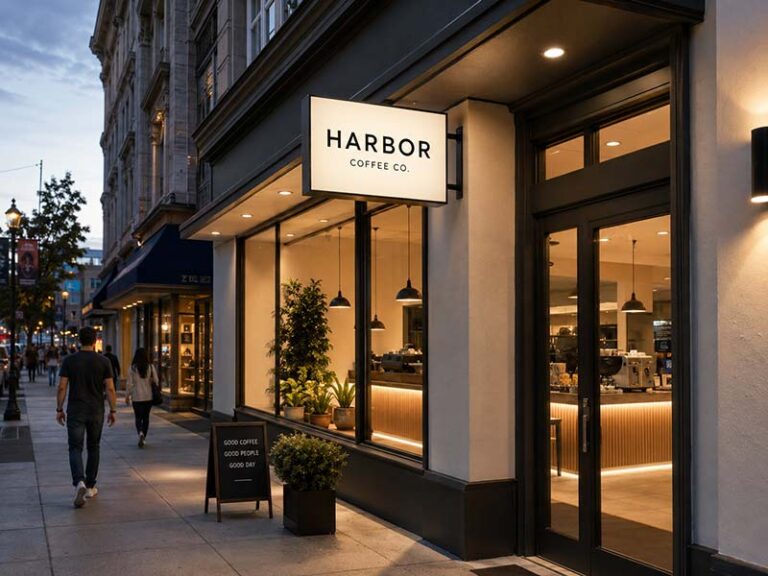

Walk along a busy retail street and the sign that helps you find a café, boutique, hotel, salon, or restaurant is often not the large sign directly above the entrance. It is the smaller sign extending outward from the building and facing people as they approach from either direction. One sign company may call it a blade sign, an architect may label it a projecting sign, and a municipal drawing may use yet another classification. The confusion sounds minor until a project moves from concept into drawings, fabrication, permitting, wiring, and installation.
Blade signs and projecting signs usually describe closely related commercial signs mounted outward from a building facade, commonly near perpendicular to the wall. In everyday sign-industry use, the two terms are often interchangeable. In architectural and regulatory contexts, however, “projecting sign” may be the broader category, while “blade sign” can refer to a particular form within it.
The real issue is therefore not deciding which term wins. A successful project needs everyone to understand the same physical product: how many faces it has, how far it extends from the wall, whether it is illuminated, what holds it up, where the wiring runs, and what local rules apply. Many expensive installation problems begin with a simple assumption that everyone means the same thing when they use the same two words.
Are Blade Signs and Projecting Signs the Same?

Blade signs and projecting signs often refer to the same general storefront concept: signage extending outward from the facade so it can be seen from side-approach directions. The distinction becomes important when architectural drawings or local regulations use “projecting sign” as a broader classification. For commercial projects, the approved dimensions, faces, mounting method, lighting, and drawings matter more than the product name alone.
What Is a Blade Sign?
A blade sign is primarily designed to solve a viewing-angle problem. A conventional wall sign faces outward from the storefront, so it works best for someone standing across the street or generally facing the building. A blade sign turns the display surface toward people moving parallel with the storefront. This makes the business easier to recognize before pedestrians have already walked past the entrance, which is particularly useful on dense shopping streets and narrow commercial frontages.
There is no single mandatory shape. Commercial blade signs can be round, square, rectangular, vertically proportioned, logo-shaped, shield-shaped, or cut to a custom contour. They can also be illuminated or non-illuminated. In iduoduo’s documented product system, the Blade Sign family includes round, square, custom-shaped, double-sided illuminated, non-illuminated, and bracket-mounted versions. The engineering focus includes the two visible faces, bracket, center of gravity, wall connection, hidden wiring, and weather protection.
Those engineering details explain why a blade sign should not be treated as an ordinary flat panel turned sideways. Once the sign projects away from the building, the bracket experiences leverage, the wall connection becomes more important, and exposed faces can receive wind and rain from several directions. An illuminated version adds internal framing, LEDs, wiring, power connections, service access, and waterproofing details. Two products may look similar in a rendering while requiring very different fabrication behind the visible face.
What Is a Projecting Sign?
A projecting sign is best understood as a description of how the sign relates to the building. Instead of remaining parallel with the facade, the sign extends outward from it. That definition can cover several physical constructions, including rigid cabinets, double-sided light boxes, hanging panels, logo-shaped boxes, and signs supported by ornamental or structural brackets. The term tells you where the sign sits, but it does not fully explain how the sign must be manufactured.
This distinction matters during procurement. A specification that says only “one projecting sign” still leaves several practical questions unanswered. The manufacturer needs to know whether the sign has one face or two, whether both sides are illuminated, the overall width and height, cabinet depth, mounting method, bracket configuration, wall material, wiring exit, power location, environmental exposure, and required finish. Without those details, two suppliers can quote very different constructions while technically responding to the same product name.
For that reason, experienced project teams eventually move away from relying on terminology and toward approved drawings. A name is useful during search and early discussion. A manufacturing drawing defines the actual object. When the drawing specifies size, depth, materials, faces, bracket, wiring, color, illumination, and mounting points, the risk of misunderstanding drops significantly.
Why Are Both Terms Used?
The signage industry operates at the intersection of fabrication, architecture, planning, retail design, electrical work, and construction. Each profession has developed its own language. A fabricator may describe a familiar product family as a blade sign, while an architect may categorize the same sign by mounting orientation and call it a projecting sign. A retail design manual may use a brand-specific term, while a city code may define a legal category that does not exactly match everyday industry language.
This is why debates over terminology rarely improve a project. The better approach is to identify the physical attributes that affect manufacturing and approval. A useful project description should confirm whether the sign is rigid or suspended, single- or double-faced, illuminated or non-illuminated, its distance from the wall, its total dimensions, and the way the bracket connects to the building. Once those items are clear, the terminology becomes much easier to manage.
| Project Question | Blade Sign | Projecting Sign |
| Typical meaning | Common commercial product style | Broader mounting or regulatory category |
| Orientation | Usually outward from facade | Outward from facade |
| Viewing direction | Commonly two directions | Depends on design |
| Number of faces | Often double-sided | Single or double |
| Illumination | Optional | Optional |
| Common support | Bracket or rigid frame | Bracket, frame, suspension, or other approved system |
| Best project control | Approved shop drawing | Approved shop drawing and local classification |
The simplest working rule is to use the terminology required by the architect, landlord, or local authority while making the manufacturing specification detailed enough that nobody has to interpret the product name.
What Makes These Signs Different?

The meaningful differences are usually found in geometry, mounting, number of visible faces, illumination, structure, and regulatory classification rather than in the words “blade” and “projecting.” Two nearly identical signs may be given different names, while two products carrying the same name can require different brackets, cabinet depths, materials, lighting layouts, and wall connections. Physical specifications provide a much more reliable comparison than terminology alone.
Is the Difference About Shape?
The word “blade” often suggests a narrow vertical panel, and some architectural documents use the term in that way. Actual commercial production is much broader. Round café signs, square retail signs, horizontal cabinets, capsules, shields, and custom logo contours are all regularly designed to project from a facade. Shape can influence how a sign is described, but it does not create a universal line between blade signs and projecting signs.
From a manufacturing perspective, shape affects far more than appearance. A compact circular cabinet keeps much of its mass relatively close to the bracket, while a long horizontal design can move more material farther away from the wall. That changes the leverage acting on the mounting points even when the two signs have a similar total weight. Narrow extensions and complex contours can also become vulnerable during fabrication, transport, and installation.
Illuminated shapes introduce another constraint: internal space. LEDs, wiring, reinforcement, retainers, and diffusion distance all need room. A logo that looks elegant on a computer screen may contain thin areas that cannot comfortably hold the intended lighting system. Good engineering may slightly adjust a contour, increase overall size, or change cabinet depth so the visual identity can be preserved without creating weak or poorly illuminated sections.
A practical shape review normally considers overall width, overall height, minimum feature width, cabinet depth, bracket attachment area, center of gravity, and shipping protection. Custom shape is valuable when it strengthens recognition, but additional complexity should have a clear visual or functional reason.
Is the Difference About Mounting?
Mounting often reveals more about the product than shape. A projecting-mounted sign extends away from the building surface so its face can address traffic moving along the facade. Blade signs naturally fit this configuration, and double-sided light boxes may use the same basic orientation. iduoduo’s product classification groups Blade Signs and double-sided light boxes within projecting-mounted signage intended for lateral street recognition.
The actual support method can vary considerably. Some signs use upper and lower rigid arms, others use a welded side frame, and some hang below an ornamental bracket. Larger illuminated cabinets may incorporate substantial mounting plates and reinforcement inside the sign body. A concealed mounting arrangement may look cleaner but can require more precise coordination between the bracket, wall penetrations, electrical route, and installer.
A lightweight non-illuminated panel and a large illuminated cabinet should never be treated as structurally identical simply because both extend at approximately the same angle. Weight, sign area, projection distance, wind exposure, and wall construction all change the load on the building. The bracket therefore belongs in the engineering stage of the project rather than being selected as a decorative accessory after the sign has already been fabricated.
Are They Always Double-Sided?
No, although double-sided construction is common because it makes full use of the projecting orientation. If people approach a storefront from both directions, two finished faces allow the sign to communicate with both streams of traffic. A typical double-sided illuminated unit may contain two translucent faces, a shared internal frame, LEDs arranged for balanced illumination, concealed wiring, and a bracket or side frame connecting the cabinet back to the building.
Not every location needs two functional faces. A sign next to a solid neighboring wall, property boundary, one-way circulation route, or architectural obstruction may receive useful traffic from only one direction. In those situations, one side may be simplified or treated differently. Directional artwork also deserves attention because arrows and asymmetric symbols cannot always be copied identically from one face to the other.
The decision should be based on actual sightlines. iduoduo’s selection guidance identifies Blade Signs and double-sided light boxes where two-direction street recognition is required and notes that single-sided signage cannot simply replace a format whose function depends on visibility from both approaches.
Which Term Should a Project Use?
The safest answer is to use the terminology found in the controlling project documents, then define the sign physically. If the architect labels the product “Projecting Sign PS-01,” keep that reference through drawings and approvals. If a landlord design manual calls the approved product a blade sign, use that term in landlord submissions. If the local permit category is projecting sign, use the code language in the permit package.
Manufacturing documentation should then remove uncertainty. A description such as “double-sided illuminated projecting blade sign, custom logo shape, aluminum cabinet, acrylic faces, wall-mounted bracket, and concealed wiring” is far more useful than either product name by itself. It tells the engineer and fabricator what is actually being built.
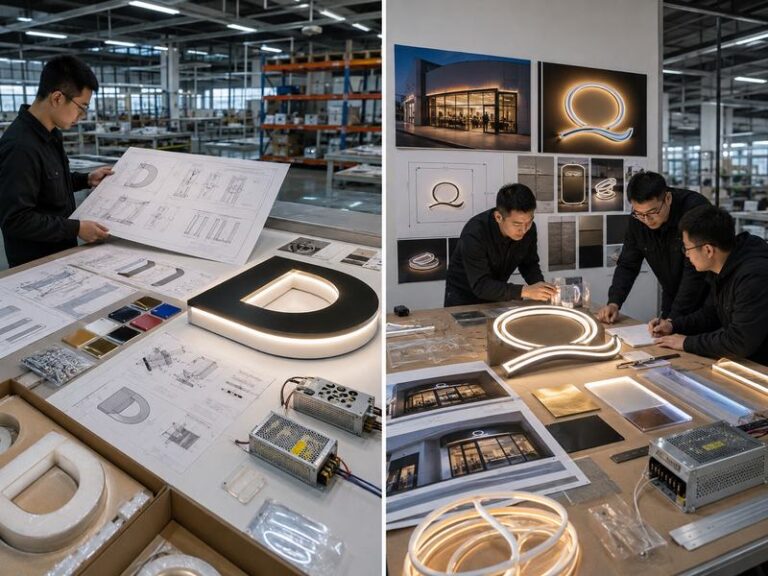
In iduoduo’s manufacturing workflow, artwork and project inputs can include AI, PDF, SVG, and CAD files, storefront photographs, wall dimensions, installation requirements, and electrical requirements. Those inputs can then be converted into production drawings, physical structures, electrical systems, and installation interfaces.
The practical rule is straightforward: product names begin the conversation, but approved drawings control the fabrication.
How Do They Improve Storefront Visibility?

Blade and projecting signs improve storefront visibility because they address people moving along the building line rather than only people looking directly toward the facade. They are particularly useful on shopping streets, restaurant rows, mixed-use developments, pedestrian corridors, and properties with narrow frontage. The sign can become visible earlier in the approach, helping visitors locate the business before they reach the doorway or pass it.
How Does Viewing Direction Change Visibility?
A flat fascia sign and a projecting sign solve different visual problems. Fascia signs normally sit parallel to the storefront and perform well when someone views the building from across the street, a car park, or another position generally facing the facade. As a pedestrian comes closer and begins moving parallel to the storefront, however, the viewing angle becomes increasingly shallow. Letters that were easy to recognize from the front can become compressed and difficult to read from the side.
A projecting sign changes that geometry. By turning its principal face toward the direction of travel, it presents a more direct view to someone approaching along the sidewalk. The sign can therefore work as an early identification point, while the larger main sign confirms the location once the person reaches the storefront.
A strong storefront system often divides visibility into different tasks rather than asking one sign to perform everything. Channel letters or a fascia sign can provide frontal recognition, a blade sign can support side-approach visibility, and window graphics can handle close-range information. This approach usually produces a clearer customer journey than simply increasing the size of the main sign.
Why Are They Effective for Pedestrians?
Pedestrian environments are slower than road environments, but they are often visually crowded. Trees, awnings, parked cars, outdoor seating, neighboring businesses, windows, temporary promotions, lighting, and people can all compete for attention. A projecting sign places the business identity closer to the pedestrian’s natural line of travel, reducing the amount of scanning required to locate a storefront.
This advantage is especially noticeable on narrow shopfronts. A business with only a few metres of frontage may have limited space for a large fascia, yet a well-proportioned blade sign can still create a strong landmark from both directions. The sign does not need to carry a long message. A recognizable logo, short brand name, or simple symbol is often more effective than a panel filled with service descriptions.
Readability depends on the relationship between lettering, contrast, mounting height, viewing distance, lighting, and surrounding clutter. An oversized sign with thin lettering can still perform poorly, while a smaller sign with strong contrast and simple artwork can be identified quickly. iduoduo’s commercial-space guidance treats Blade Signs as products where viewing direction, mounting height, readability, pedestrian movement, and actual site conditions should be evaluated together.
Do They Work for Vehicle Traffic?
Projecting signs can also support vehicle recognition, but a sign intended for moving traffic requires a different design mindset. Drivers have less time to process visual information and may view the sign from farther away than pedestrians. Road speed, lane position, setbacks, street trees, parked vehicles, mounting height, and surrounding signs all affect the time available to recognize a logo or business name.
That normally favors simpler graphics, larger lettering, higher contrast, fewer words, and clear illumination where nighttime visibility is required. A compact boutique sign that performs very well for pedestrians five or ten metres away may not be useful to a driver farther from the storefront. Enlarging the blade sign is not always the best solution because more size also means more weight, wind area, projection, packaging volume, and structural demand.
For many commercial properties, the more efficient solution is a coordinated system. Larger building letters or a main fascia can address long-range vehicle recognition, while the blade sign provides confirmation for people moving closer to the entrance. Each sign then performs a specific job rather than competing with the others.
Which Businesses Use Them Most?
Blade and projecting signs are particularly useful where visitors must choose between several nearby entrances. Restaurants, cafés, boutiques, beauty businesses, bars, hotels, galleries, clinics, offices, shopping centres, and mixed-use developments all use them because side-angle recognition can be as important as front-facing identification. The exact design should still reflect how the business operates rather than copying a generic storefront reference.
A restaurant may benefit from illumination because evening visibility is important, while a boutique may prefer a small non-illuminated metal sign that suits the architecture. A hotel entrance may justify a larger illuminated cabinet because guests approach from farther away. A multi-store retail program may care less about a dramatic custom shape and more about reproducing the same proportions, bracket geometry, colors, and lighting across many locations.
A complete storefront system can divide functions clearly: the main fascia identifies the brand from the front, the blade sign assists side-approach recognition, window graphics carry promotional or service information, an opening-hours sign provides operational details, and interior signs support navigation after the customer enters. This system-based approach is usually more useful than treating each sign as an isolated product.
Which Designs and Lighting Options Work Best?

The best design depends on the actual site rather than a single preferred construction. Viewing direction, operating hours, brand identity, wall conditions, ambient light, maintenance access, weather exposure, and local restrictions all influence the decision. Illuminated signs are valuable when nighttime recognition matters, while non-illuminated signs can be lighter, simpler, easier to maintain, and more appropriate for some architectural environments.
Which Blade Sign Shapes Are Available?
Commercial blade signs can be produced in round, square, rectangular, oval, vertical, horizontal, shield-shaped, logo-shaped, and custom-contour formats. The practical question is not whether a shape can be drawn in design software. It is whether the finished form can be fabricated with enough internal strength, illuminated evenly if required, packed safely, installed accurately, and maintained later without damaging the visual concept.
Compact round or square cabinets are often straightforward because they provide useful internal space and predictable structural geometry. Custom contours can create a stronger connection to the brand, but narrow projections and tight internal corners may reduce the space available for LEDs, reinforcement, wiring, retainers, or service access. Some shapes also create fragile points that need additional protection during international transport.
For illuminated products, extremely thin sections can make uniform lighting difficult. The face may sit too close to the LEDs, causing visible hotspots, while narrow sections may not accommodate the chosen LED module. A small adjustment in overall size or depth can sometimes preserve the logo far better than trying to force a visually elegant drawing into a physically unsuitable cabinet.
iduoduo’s documented Blade Sign range includes round, square, custom-shaped, illuminated, non-illuminated, and bracket-mounted configurations, allowing the structure to be selected around the actual storefront rather than a single preset format.
Which Materials Can Be Used?
Most blade signs are systems made from several materials rather than a single material. The cabinet may use aluminum, the structural bracket may use steel or stainless steel, the illuminated face may use acrylic or another translucent panel, and the visible graphics may be painted, printed, applied as vinyl, or fabricated as separate dimensional elements. Material selection therefore needs to consider weight, rigidity, corrosion resistance, finish, optical performance, and long-term service conditions together.
Aluminum is widely useful for sign cabinets because it offers a practical balance of weight, corrosion resistance, and fabrication. Steel may be preferred for brackets or structural elements that need greater stiffness, while stainless steel can be suitable where corrosion resistance or a particular decorative finish matters. Acrylic is frequently used for illuminated faces because its transmission and diffusion properties can help create an even luminous surface.
| Component | Common Material | Main Project Consideration |
| Cabinet or frame | Aluminum | Weight, rigidity, fabrication, corrosion protection |
| Structural bracket | Steel or stainless steel | Strength, welding, coating, fixing method |
| Illuminated face | Acrylic or other translucent face | Transmission, diffusion, color, outdoor exposure |
| Non-illuminated face | Metal, acrylic, composite panel | Flatness, finish, durability |
| Graphics | Paint, vinyl, print, fabricated elements | Brand color, detail, weather resistance |
| Lighting | LED modules or suitable LED system | Spacing, brightness, heat, serviceability |
| Fasteners | Stainless or project-specified hardware | Corrosion, strength, compatibility |
The heaviest material is not automatically the safest choice. Adding thickness increases weight and places more demand on the bracket and building connection. Reducing thickness too far can cause vibration, deformation, poor flatness, or weak fixing points. Material thickness should therefore follow the sign size, cabinet depth, geometry, and installation conditions rather than a universal specification.
Are Illuminated Signs Better?
Illuminated signs are better only when illumination solves an actual visibility problem. Restaurants, hotels, bars, convenience retail, entertainment venues, and businesses operating after dark can benefit substantially from internal lighting because the brand remains identifiable when the surrounding environment becomes darker. Illumination can also help in visually competitive commercial districts where neighboring stores remain bright late into the evening.
A non-illuminated sign can still be the stronger choice for daytime businesses, heritage streets, premium boutiques, office entrances, and locations with strong ambient lighting. Removing the lighting system can reduce cabinet depth, electrical work, internal components, maintenance, and total weight. In some architectural settings, a well-finished metal or painted sign also feels more appropriate than a luminous box.
Before specifying illumination, the project team should consider opening hours, surrounding light levels, available power, local restrictions, maintenance access, and the brand’s visual language. Adding LEDs simply because they are available is not a design strategy. The useful question is whether illumination materially improves recognition during the hours when the business needs to be found.
How Does Double-Sided Lighting Work?
A double-sided illuminated cabinet must create acceptable brightness on two opposite faces while fitting the lighting system, wiring, internal structure, and service access inside one sign body. That requires a balance between cabinet depth, face diffusion, LED type, LED spacing, internal reflection, and total power. A cabinet that is too shallow can reveal individual light points, while poor spacing can create bright areas near the LEDs and darker zones elsewhere.
Adding more LEDs is not automatically the solution. Excessive LED density can increase power consumption and heat without producing a proportional improvement in appearance. The better approach is to coordinate the optical cavity as a system. Face material, internal depth, module beam angle, reflective surfaces, wire routing, and heat management should all work together.
For iduoduo’s relevant illuminated Light Box and Blade Sign projects, the documented manufacturing process includes LED optical layout, power and wiring review, service access, weather protection, bracket fabrication, mounting preparation, 100% lighting inspection, and 72-hour pre-shipment testing. This type of process is particularly useful on double-sided products because one acceptable face does not automatically guarantee that the opposite face has the same uniformity.
How Are Blade Signs Mounted Safely?

A blade sign behaves like a cantilevered object attached to a building, so safe installation depends on the relationship between sign weight, projection distance, bracket geometry, wall structure, fixing method, and environmental exposure. The mounting system should be considered during product engineering, not after fabrication. Larger outdoor signs may also require local structural review because the manufacturer cannot verify hidden conditions inside every building facade.
How Does the Bracket Support the Sign?
The bracket transfers the weight of the sign back into the building, but weight alone does not describe the full load. Projection creates leverage. If the same sign mass is moved farther away from the wall, the moment acting on the mounting points increases. Wind can add further forces, particularly on broad sign faces installed in exposed locations. A small change in projection can therefore matter more structurally than it appears in a rendering.
A practical bracket review should consider total product weight, sign width and height, cabinet depth, projection distance, center of gravity, exposed sign area, fixing-point arrangement, and the building substrate. Decorative appearance can still be important, but the visual bracket shape needs to work with those engineering requirements.
iduoduo’s Blade Sign engineering framework specifically identifies the bracket, center of gravity, wall connection, concealed wiring, and waterproofing as core product issues. For larger or highly exposed signs, the local structural team may need to review the final connection and wind conditions before installation. That is particularly important when the sign is high above grade or attached to lightweight cladding.
Which Wall Conditions Matter?
The visible surface of a building does not always reveal what is actually capable of supporting the sign. Concrete, solid masonry, brick veneer, structural steel, timber framing, metal cladding, curtain walls, and insulated facade systems require different anchoring strategies. A fixing method that performs well in concrete may be completely inappropriate when the visible facade is only a thin decorative skin over another structure.
Useful project information therefore includes the wall construction, cladding thickness where relevant, location of structural members, available internal access, permitted fixing zone, electrical entry point, and existing waterproofing system. For straightforward signs, good photographs and accurate measurements may provide enough information for the factory to prepare a suitable mounting interface. Larger projects may require architectural drawings or structural details.
The manufacturer can fabricate mounting plates, brackets, holes, templates, and cable exits according to approved project information. The local project team still needs to confirm that the proposed anchors and structural substrate are suitable for the building. This distinction prevents the product manufacturer from making assumptions about conditions that are hidden behind the facade.
How Are Wires and Power Concealed?
Electrical planning is easiest when the wire route is decided before the bracket is fabricated. Low-voltage cables may pass through a hollow bracket, behind a mounting plate, through the rear of the cabinet, or directly through the facade into an accessible building space. The best arrangement depends on the product structure, power-supply location, local electrical rules, and the amount of access available after installation.
Wire-exit position may seem like a small detail, but it can create disproportionate problems when it is wrong. If the cable exits several centimetres away from the intended wall penetration, the installer may need to drill another hole, add visible conduit, modify the bracket, or leave wiring exposed. These changes can affect both appearance and weather protection.
Power-supply location also needs to be confirmed. Depending on the design, it may be placed in an accessible cabinet section, behind the sign, inside the building, or in another approved location. Outdoor wall penetrations should be considered part of the weather-protection system because rain can travel along wiring and fasteners even when the factory-made cabinet itself is well sealed.
How Do Outdoor Conditions Affect Mounting?
Projecting signs receive environmental exposure differently from flush-mounted wall signs. Wind acts on a surface positioned away from the facade, while rain can reach the top, bottom, sides, front, rear, bracket, and cable penetrations. Sunlight affects coatings, plastics, printed graphics, and sealants. Temperature changes cause metal and acrylic to expand at different rates, and coastal environments can increase corrosion risk.
Outdoor design therefore needs to consider wind exposure, drainage, sealing, metal protection, fastener material, coating durability, cable entries, thermal movement, and future maintenance. A weather-resistant sign body does not automatically create a weather-resistant installation. Wall penetrations, anchors, site-applied sealant, wiring routes, and installation direction all remain part of the completed system.
For Light Boxes, Blade Signs, and Cabinet Signs, iduoduo’s documented inquiry checklist covers around 20 project inputs, including product type, face configuration, dimensions, shape, quantity, artwork, face material, frame color, indoor or outdoor use, light color, voltage, power, bracket, wall type, cable exit, waterproofing, destination, packaging, and required project date. Gathering this information before fabrication is considerably more useful than requesting a quote based only on a photograph and approximate width.
Do Blade Signs Need Permits?

Many permanently installed blade and projecting signs require some form of local approval, although the exact rules vary by municipality, property, district, building, and installation method. Regulations may control sign area, projection, mounting height, pedestrian clearance, spacing, illumination, electrical work, structural attachment, and encroachment. Project teams should confirm the applicable local rules before final manufacturing dimensions and brackets are approved.
Do Local Sign Codes Use Different Terms?
Yes. Sign terminology is not globally standardized, and this is one of the main reasons the distinction between blade signs and projecting signs causes confusion. One jurisdiction may use the terms almost interchangeably, another may define a blade sign as a subtype of projecting sign, and another may classify products according to whether they are rigid, suspended, illuminated, attached above a public walkway, or located within a particular design district.
This means an approved sign from one city should not be copied into another project under the assumption that the same dimensions, projection, or lighting arrangement will automatically be allowed. Local codes, landlord criteria, historic-district rules, and property-specific design manuals can create different requirements even when the signs look nearly identical.
For international projects, responsibilities are usually divided. The manufacturer provides product drawings and fabrication information, the architect or sign consultant coordinates the design, the structural engineer reviews structural conditions where required, the installer handles site fixing, the electrician completes local electrical work, and the permitting authority interprets the local rules. That separation is more reliable than asking one party to take responsibility for every jurisdiction.
Which Dimensions Are Usually Regulated?
Projecting signs are commonly regulated because they extend away from a private building surface and may approach pedestrian areas, public rights-of-way, neighboring properties, or other signs. Typical controls can include the overall sign area, distance projected from the facade, minimum clearance above walking areas, maximum mounting height, cabinet thickness, spacing between signs, setbacks, and the permitted number of projecting signs along one frontage.
There is no responsible universal dimension that can be applied to every project. A projection distance accepted on one street may not be permitted in another jurisdiction. Historic areas can impose stricter proportions, while shopping centres may have landlord design criteria that are more restrictive than the municipal code.
The practical lesson is to perform the code and property review before a custom cabinet and bracket enter production. Changing the allowable projection after fabrication can affect the bracket length, center of gravity, mounting plate, wiring, structural demand, shipping dimensions, and visual proportions. Early confirmation is usually far less expensive than redesigning a completed sign.
Are Illuminated Signs Regulated Differently?
Illuminated signs can introduce additional requirements because they combine a physical sign structure with an electrical and visual lighting system. Depending on the jurisdiction or property, the project may need to address brightness, light spill, flashing, animation, color, operating hours, electrical certification, wiring method, power connection, and maintenance access. Historic districts may also restrict internal illumination even when non-illuminated projecting signs are accepted.
Landlords and shopping centres frequently maintain their own storefront manuals. These documents can specify approved color temperatures, cabinet depths, face materials, logo proportions, mounting locations, or whether illuminated blade signs are permitted at all. A design that satisfies the municipal code can still require modification before a property owner approves it.
A practical sequence is to confirm the sign category first, then confirm the maximum permitted envelope, property or landlord criteria, illumination concept, electrical requirements, and only after that approve the final manufacturing drawing. This order addresses the most expensive constraints before the factory commits materials and fabrication time.
Who Confirms Final Compliance?
Final compliance normally involves several parties because no manufacturer controls the building, local code, installation site, and electrical system at the same time. The factory can control the product it makes: dimensions, cabinet structure, materials, lighting system, bracket fabrication, mounting holes, wire exits, finish, inspection, and packaging. The local team controls site-specific conditions and legal approval.
iduoduo’s documented project boundaries reflect this division. The manufacturing side can support dimensions, materials, electrical specifications, mounting details, structure information, product photographs, and installation interfaces, while local permitting, structural approval, wind-load calculations, high-level access, facade fixing, and final site acceptance are normally handled by the appropriate local professionals. This approach keeps responsibilities attached to the parties that can actually verify them.
For factory planning, current reference ranges for iduoduo Light Boxes, Blade Signs, and Cabinet Signs include the following documented production conditions.
| Production Item | Reference Range or Control |
| MOQ | From 1 piece |
| Standard sample or single unit | About 5-7 days |
| Special shape, complex bracket, or larger project | About 7-15 days |
| Small batch | About 7-10 days |
| Medium batch | About 10-20 days |
| Illuminated-product lighting inspection | 100% inspection |
| Pre-shipment test | 72 hours |
| Warranty framework | 3 years |
These figures are manufacturing references rather than total project lead times. Architectural review, landlord approval, permitting, international transport, customs clearance, local delivery, and installation can all add separate time. A realistic schedule should treat those stages independently instead of assuming that factory production time equals the complete project duration.
Conclusion
The difference between a blade sign and a projecting sign is much less important than understanding what the sign must accomplish and how it will be built. In many commercial situations, the terms describe closely related or even identical products. The distinction becomes meaningful when an architect, landlord, sign code, or permit authority gives the terms a specific definition. At that point, the approved project documents should take priority over casual industry language.
A reliable project starts with the actual conditions: who needs to see the sign, from which directions, at what distance, during which hours, and on what kind of building. From there, the team can confirm face configuration, dimensions, materials, cabinet depth, illumination, bracket, wall connection, wiring, weather exposure, and maintenance access. When those questions are resolved early, the sign is easier to manufacture, approve, ship, and install.
For a custom commercial project, useful starting information includes the logo or artwork, target size, storefront elevation or photographs, expected viewing directions, indoor or outdoor location, illuminated or non-illuminated preference, wall condition, destination market, and project schedule. iduoduo can then review the product from the manufacturing side, including structure, lighting, bracket arrangement, wiring, mounting preparation, packaging, and production feasibility without replacing the local professionals responsible for permits and site conditions.
Frequently Asked Questions
Are blade signs and projecting signs the same thing?
They are often used as interchangeable terms in everyday commercial signage, especially when describing a sign mounted outward from a storefront and visible from side-approach directions. However, “projecting sign” can be a broader architectural or regulatory classification, while “blade sign” may describe one particular style. The safest approach is to check the terminology used in the project drawings and local sign code while defining the physical product through dimensions and specifications.
Are blade signs usually double-sided?
Many blade signs are double-sided because the projecting orientation naturally serves people approaching from two opposite directions. Double-sided construction is particularly useful on pedestrian streets, restaurant districts, retail rows, and mixed-use developments. It is not mandatory, however. A site with one dominant viewing direction or a physical obstruction on one side may not need two functional faces, so the viewing conditions should be confirmed before fabrication.
Can a blade sign be illuminated?
Yes. Blade signs can be non-illuminated or internally illuminated, and some designs can also use external lighting depending on the architecture and local rules. Internally illuminated versions typically require a cabinet, translucent faces, LEDs, wiring, power components, service access, and weather protection. Illumination is most valuable when a business operates after dark or requires stronger nighttime recognition, but it should not be added automatically when a simpler non-illuminated sign would perform the job.
What materials are commonly used for projecting signs?
Common constructions use aluminum for cabinets, steel or stainless steel for structural brackets, acrylic or other translucent materials for illuminated faces, and painted metal, composite panels, or acrylic for non-illuminated faces. The best combination depends on sign size, weight, outdoor exposure, finish, lighting, and installation method. Material thickness should be engineered around the product rather than selected from a universal standard because unnecessary weight can increase bracket and wall loads.
How high should a projecting sign be installed?
There is no single installation height that applies everywhere. Local codes can regulate minimum pedestrian clearance, maximum sign height, projection distance, spacing, and relationship to the public right-of-way. Landlords and historic districts may impose additional requirements. The correct installation height should therefore be confirmed against the specific site, architectural drawings, local sign regulations, and viewing conditions before the bracket and final manufacturing dimensions are approved.
Do blade signs need a permit?
Many permanently installed outdoor blade and projecting signs require local approval, but the requirement depends on the municipality, property, sign size, illumination, mounting method, and location. Some projects may also need landlord approval, structural review, electrical approval, or right-of-way clearance. The manufacturer can provide product and mounting information, but the local project team should confirm the permit category and final compliance requirements before installation.
What information is needed to quote a custom blade sign?
A useful quotation package normally includes the logo or artwork, target width and height, required quantity, single- or double-sided configuration, illuminated or non-illuminated preference, indoor or outdoor location, preferred materials or finish, wall type, bracket concept, wiring or power information, destination country, and required project date. The more complete these inputs are, the easier it is to evaluate structure, lighting, mounting, packaging, and production accurately rather than pricing from appearance alone.