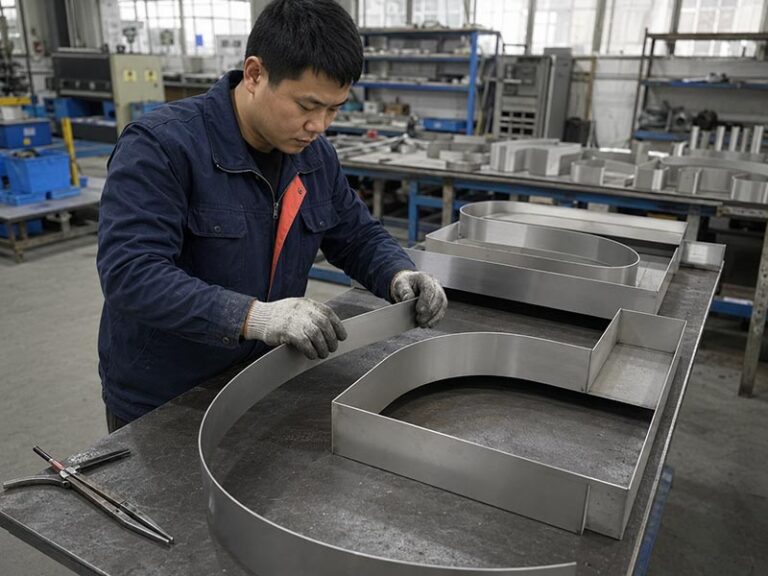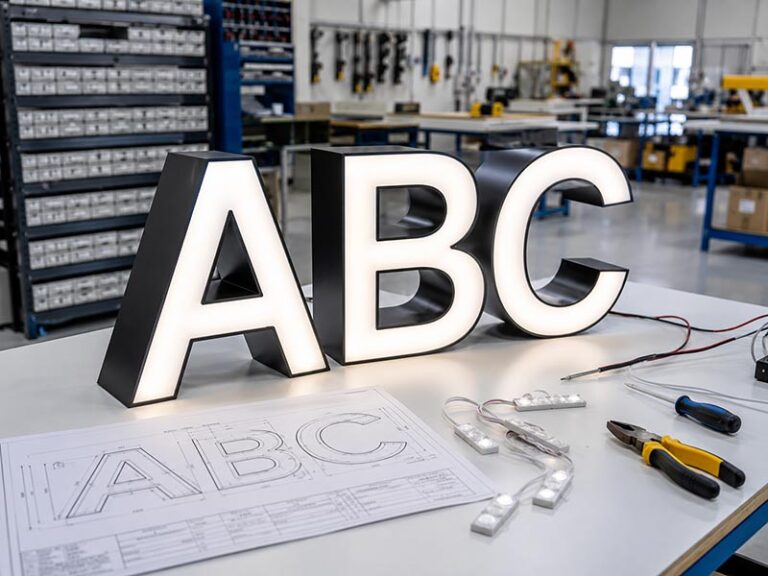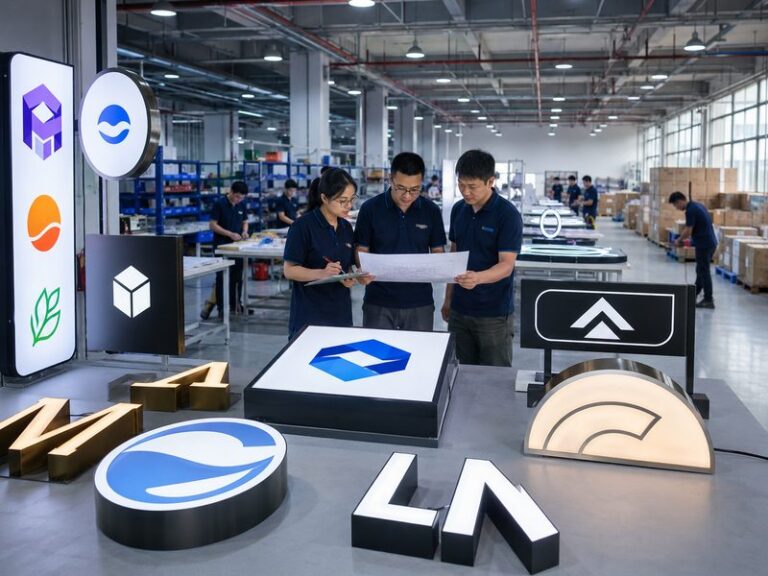

A finished channel letter can look flawless on the factory inspection table and still arrive overseas with a cracked acrylic face, bent return, scratched coating, damaged mounting stud, or missing power supply. The reason is simple: international shipping exposes the product to a completely different set of forces than normal installation. A shipment may pass through trucks, freight terminals, forklifts, warehouse stacks, aircraft or containers, customs inspections, local distribution centers, and final delivery before an installer touches the first letter.
The safest way to package channel letters for export is to protect every letter individually, keep fragile surfaces away from structural loads, stop all uncontrolled movement inside the package, separate heavy electrical and installation parts, and select the carton, pallet, wooden frame, or plywood crate according to product size, weight, finish, shipping method, and destination requirements. Final packing should also be inspected, numbered, documented, and matched to the installation set.
Most transport damage does not begin with a spectacular accident. A letter may move only a few millimeters inside a box, but it can do that thousands of times during a long journey. A power supply may slowly rub against a face. A mounting stud may carry pressure whenever cartons are stacked. A painted return may press against foam that is too hard. The outside of the package can still look acceptable when it arrives, yet the installer opens it and finds a problem that started days or weeks earlier. Good export packaging is designed to prevent that chain of events before the shipment leaves the factory.
What Packaging Risks Must Channel Letters Survive?

Channel letters must survive compression, vibration, impact, surface abrasion, repeated handling, moisture exposure, stacking, and movement inside the package. The most effective packing system considers the complete transport journey rather than only the moment the carton is sealed. Product construction, weight, surface finish, mounting hardware, electrical parts, freight method, destination, and the number of handling stages all affect the level of protection required.
Where Damage Usually Starts
Channel letters appear rigid once they are fixed to a storefront, but many of their individual components are relatively vulnerable during transportation. An acrylic or polycarbonate face is intended to maintain its shape and diffuse light during normal use; it is not designed to carry heavy stacking pressure. Thin aluminum or stainless-steel returns can hold a finished letter together very well, yet a concentrated side load can still deform an edge or corner. Rear studs and stand-offs are particularly easy to overlook because they project outside the main body and can bend when another component presses against them.
Different letter constructions create different weak points. Front-lit letters usually require careful face and trim protection. Halo-lit letters need additional rear clearance around studs, stand-offs, transparent backs, wire exits, and lighting components. Front-and-halo-lit products have sensitive structures on both sides. Raceway-mounted systems introduce long structural parts that may be heavier than the individual letters and should not be allowed to move against finished surfaces during shipment.
A practical packaging review should therefore identify the face, return, rear structure, mounting hardware, wire exits, trim, electrical components, painted or polished surfaces, templates, and loose accessories before protective material is selected. iduoduo’s documented packaging process specifically identifies face pressure, return deformation, bent studs, paint abrasion, wire pulling, letter collision, trim damage, and mixed store sets as risks that need to be controlled.
Load, Vibration, and Contact
Three forces deserve particular attention: compression, impact, and repeated movement. Compression comes from stacking, straps, adjacent freight, or handling equipment. Impact occurs when a carton is dropped, pushed, tilted, or struck. Repeated movement happens when a letter has enough free space to shift inside the package during trucking, aircraft vibration, vessel movement, or repeated loading and unloading.
Small movement is often underestimated because it does not look dramatic. If a painted edge slides a few millimeters against a divider every time a truck changes direction, the total number of rubbing cycles over an international journey can be significant. The same is true for a power supply or metal bracket. These parts may be much smaller than the sign itself, but their weight becomes damaging when they repeatedly strike an acrylic face or thin metal return.
Good packaging therefore needs a predictable load path. External pressure should be carried by the carton, crate, internal structure, and strong areas of the sign. It should not be transferred through the acrylic face, exposed trim, narrow decorative strokes, wiring, or mounting studs. Cushioning alone is not enough if the product is supported in the wrong place.
| Packaging Risk | Most Vulnerable Area | Possible Result | Practical Control |
| Stacking pressure | Acrylic or PC face | Cracking, bowing, permanent deformation | Rigid outer package, face clearance, distributed support |
| Repeated vibration | Painted or polished surfaces | Scratches, rubbing marks, coating wear | Individual separation, soft layers, fixed positions |
| Side impact | Returns and corners | Bent edges, distorted corners | Corner blocks, side clearance, stronger outer walls |
| Loose accessories | Faces, backs, wiring | Dents, cracks, broken terminals | Separate accessory compartment and fixing |
| Rear compression | Studs and stand-offs | Bent hardware, damaged backplates | Rear clearance and controlled support |
| Mixed components | Multi-store programs | Wrong sign or hardware at site | Store, product, SKU, and box numbering |
Packaging Risk Review
The packaging plan should start with the product rather than with the available box. The first questions are practical: How heavy is each letter? Where can it safely carry load? Does the product have narrow strokes, projecting studs, detachable trim, a large acrylic face, a delicate finish, or a raceway? Will the shipment travel as a parcel, consolidated air freight, LCL sea freight, or a full container load? Each answer changes the way the internal support should be designed.
The receiving environment matters as well. A crate sent to a professional warehouse with forklifts can be handled differently from a package delivered directly to a retail store with no dock. Oversized freight may require a tail-lift truck, loading appointment, or several people for unloading. A product that is perfectly protected inside the crate can still become difficult or unsafe to handle if the package dimensions, weight distribution, or lifting direction were never considered.
There is no universal foam thickness, carton grade, or crate dimension that works for every channel letter. Two letters with the same overall height can require completely different support because one may have broad, strong strokes while the other contains thin extensions that flex easily. iduoduo’s documented packaging inputs therefore include product type, dimensions, weight, material, finish, quantity, studs, brackets, power supplies, fragile areas, number of stores, shipping method, destination, and whether the project requires multi-address or reusable packaging.
How Should Each Channel Letter Be Protected?

Every channel letter should be treated as a finished individual component before several letters share the same carton or crate. Protection normally begins with a compatible surface layer, followed by cushioning and support around structurally suitable areas, then separation from neighboring products. Heavy hardware, power supplies, metal brackets, studs, and electrical parts should never be able to touch or move against visible faces and finished surfaces.
Face and Finish Protection
The first layer of packaging should protect the visible finish rather than simply make the product feel padded. Acrylic, brushed stainless steel, mirror stainless steel, painted aluminum, polished metal, and printed surfaces have different sensitivities. A material that works well against one surface may leave pressure marks, adhesive residue, or abrasion on another, especially during a long journey that includes heat, humidity, and repeated movement.
Protective film is useful on many acrylic and metal surfaces when the adhesive and film are compatible with the product. It should remain attached during transportation, release without residue, and avoid reacting with paint or decorative finishes. The main film on mirror or brushed surfaces is often best left in place until installation is nearly complete because the risk of fingerprints and scratches continues after the letter has been removed from its packaging. iduoduo’s packing specifications identify clear acrylic, opal acrylic, mirror acrylic, mirror stainless steel, brushed stainless steel, glossy metal, and selected painted or printed surfaces as areas where protective film may be used.
Painted products also need sufficient curing time before packaging. A coating that feels dry on the surface may still be vulnerable to pressure marks if it is compressed against foam for days. Packing too early can cause impressions, changes in gloss, material transfer, or adhesion between the finish and packaging layer. Surface protection therefore begins with production control, not with wrapping.
Foam and Support
Foam should be selected according to the job it has to perform. Common materials include EPE, pearl cotton, EVA, custom-cut foam, soft separators, paper dividers, and honeycomb board. The choice should depend on product weight, finish sensitivity, support area, freight method, stacking pressure, and the position of the letter inside the package rather than on a belief that thicker or harder foam is always safer.
Very soft foam can compress completely under a heavy letter and allow the product to contact the box wall. Very hard foam can create concentrated pressure on a painted or acrylic area, especially when the contact surface is small. A better arrangement spreads the load across structurally stronger areas and keeps fragile faces away from direct pressure. Thin strokes and long narrow components may need several support points to prevent bending between supports.
Corner protection is also valuable because external impacts frequently reach a product through corners and edges. Foam, paper, plastic, wood, or combined structures can be used depending on the sign geometry and weight. After the package is closed, the product should stay in its intended position when the carton is carefully moved. It should not sink, tilt, or find a new contact point after the cushioning compresses.
Separation and Movement Control
When several letters share one carton or crate, each component should have a defined position. Individual sleeves, foam pockets, layered inserts, partitions, and custom slots can all work when they are shaped around the real product rather than placed randomly around empty space. The goal is not to fill every gap; the goal is to prevent the product from moving into an area where it can damage itself or another component.
Finished surfaces should never be allowed to rub directly against each other. Metal should not slide over acrylic, mirror stainless steel should not contact hard hardware, and installation accessories should not migrate from their intended compartment into the letter area. Heavy accessories require positive fixing because gravity and vibration will eventually move them if they are only placed loosely between pieces of foam.
iduoduo’s documented internal-packing process includes individual wrapping or foam, layered separation, dividers, dedicated positions, product codes, and prevention of surface-to-surface friction. It also states that metal letters, acrylic panels, and installation hardware should not move freely inside the carton.
For higher-risk projects, closing the carton should not be the final check. A controlled movement inspection can reveal whether something is still shifting inside. Depending on project requirements, packaging verification may also include simulated handling, load checks, corner inspection, stacking review, opening tests, sample shipments, or agreed drop and vibration testing.
Which Carton or Crate Should You Use?

The right outer package is the lightest practical structure that can still protect the channel letters throughout the actual transport route. Reinforced corrugated cartons work well for many small and medium products, while heavier, oversized, high-value, or freight-intensive projects may need double-wall reinforcement, pallets, wooden frames, or plywood crates. Outer strength and internal restraint must be designed as one system rather than chosen separately.
Reinforced Cartons
Corrugated cartons are efficient when the product is manageable in size and weight and a secure internal insert can keep the letter away from the outer walls. They are especially useful for suitable express and air shipments because they usually add less weight than a crate and can help control volumetric freight cost. The decision still depends on the product and route rather than on size alone.
Carton selection should consider actual weight, external dimensions, volumetric weight, stacking, internal lining, secondary handling, destination humidity, and the likelihood of repeated transfer between vehicles or warehouses. A shipment that looks simple at the factory may still pass through several distribution points before delivery. iduoduo’s packaging criteria include product weight, dimensions, volumetric weight, courier handling, stacking, internal lining, destination, rain or humidity exposure, and secondary transportation.
When a normal carton is not enough, reinforcement can include double-wall corrugated material, double-box construction, stronger edge protection, internal frames, timber stiffeners, or palletization. The key point is that external strength does not replace internal restraint. A very strong carton with a loose letter inside can still allow the product to damage itself, while excellent internal foam cannot compensate for an outer carton that collapses under stacking pressure.
Plywood Crates and Frames
Plywood crates become useful when channel letters are too large, heavy, fragile, or valuable for conventional carton handling. Large letters, long raceways, oversized backboards, delicate mirror finishes, and products moving through air or sea freight may benefit from a rigid enclosure that can be handled by forklifts and tolerate higher external loads.
A well-designed crate provides enclosed protection, compression resistance, stronger stacking capability, defined forklift handling, internal framing, and secure attachment points for heavy parts. iduoduo’s crate system identifies these functions specifically for larger channel letters, light boxes, backboards, acrylic logos, high-value finishes, and air or sea freight projects.
Open wooden frames can also be useful for large letters, long backboards, and projects where total packaging weight needs to be reduced. An open frame does not remove the need for foam, surface protection, internal fixing, corner protection, moisture control, and handling marks.
The decision is therefore not simply that cartons are for lower-value projects and crates are for premium ones. A large but structurally strong product might use a frame, while a smaller high-value mirror-finish logo could justify a closed crate. Handling risk, weight distribution, finish sensitivity, stacking environment, freight mode, and destination equipment are more useful decision factors.
| Outer Package | Most Suitable For | Important Features | Main Trade-Off |
| Reinforced carton | Small and medium letters | Shaped inserts, strong walls, edge protection | Low weight but less rigid under heavy stacking |
| Double carton | Longer parcel routes | Independent inner and outer layers | More volume but improved impact isolation |
| Carton on pallet | Several cartons or heavier sets | Strapping, anti-tip control, visible labels | Easier warehouse handling but larger footprint |
| Wooden frame | Large or long products | Internal fixing, moisture protection, lifting points | Lower enclosure weight but less closed protection |
| Plywood crate | Large, fragile, high-value air or sea freight | Internal frame, forklift access, stacking strength | Greater packaging weight and volume |
Oversized Sets
Oversized channel letters should be engineered around transportation limits before the product is completed. Packaging can influence whether a backboard should be divided, whether a bracket should be removable, how long a raceway can be, where electrical connectors are placed, how studs are protected, and in what sequence the installer will reassemble the system on site.
This matters because the practical shipping limit is not defined only by the factory. A completed assembly may also need to pass through container doors, warehouse entrances, elevators, narrow shopfronts, stairways, local delivery vehicles, and installation access areas. If a finished sign cannot pass through these points, solving the problem after manufacturing usually leads to unnecessary cutting, repacking, or installation changes.
iduoduo’s packaging documentation specifically notes that transportation planning can affect product segmentation, removable brackets, backboard dimensions, raceway length, power-supply position, connector design, stud length, crate size, transportation cost, local handling, and installation sequence.
When a large system is divided, each section should carry consistent identification. Mechanical joints, electrical connectors, templates, accessory kits, and crate positions should follow the same numbering method. Packaging can also follow the installation sequence so that the local team does not have to unload every part simply to find the first component needed on the wall.
How Do You Pack Accessories and Multi-Store Sets?

Power supplies, controllers, hardware, templates, and spare parts should be managed as controlled project components rather than loose items added before the box is closed. Each group should be physically separated, secured, labeled, and matched to the correct product, store, SKU, and box. In multi-store programs, consistent identification from production through installation can prevent errors that physical protection alone cannot solve.
Power and Controls
Power supplies are compact, dense components. If one is left loose next to an acrylic face, it can cause serious damage even though it represents only a small part of the sign’s total weight. The power supply should therefore be independently bagged or boxed, fixed inside a dedicated area, and kept away from visible faces, thin returns, wiring, and other vulnerable structures.
Useful identification can include input voltage, output voltage, quantity, product number, and the sign set to which the power supply belongs. Terminals also need protection against direct impact. iduoduo’s packing process requires power supplies to be separately packaged or boxed, fixed in position, identified by input and output voltage, linked to the corresponding product, and prevented from striking the sign during transportation.
Controllers, dimmers, and remote controls need similar organization. They should have separate protection, product identification, input and output information, and connection instructions where necessary. Buttons should not sit under continuous pressure, and remote controls may need pairing information. If batteries are included, their transport requirements should also be checked for the selected freight mode before dispatch.
This system improves more than physical safety. An undamaged power supply delivered to the wrong store can delay an installation just as effectively as a damaged one, so information control is part of export packaging.
Hardware and Templates
Small installation parts are inexpensive compared with a full set of channel letters, yet missing hardware can stop an installation crew completely. A set may arrive with every illuminated letter working correctly, but one missing mounting plate, connector, or stud package can turn a scheduled installation into a return visit with additional labor and project delays.
Accessory kits can include screws, nuts, washers, wall plugs, studs, decorative caps, suspension hardware, steel cables, connection wires, brackets, mounting plates, and spare components. The bag or box should be identified using relevant project, store, SKU, box, product, and quantity information. iduoduo’s documented accessory controls follow this type of labeling system.
Installation templates also require deliberate packaging. Depending on size and material, they can be rolled, folded where appropriate, placed in a rigid tube, bagged separately, packed with the corresponding sign, or given their own box number. Moisture, tearing, unclear scaling, and mixing templates between locations are common risks even though the template itself has little material value.
For larger projects, the Packing List should be treated as a control document rather than only a shipping form. It can show the store, box number, product code, product name, quantity, power supplies, controllers, accessories, templates, packaging dimensions, net weight, gross weight, and destination.
Store and Box Coding
Multi-store projects change the purpose of packaging because the shipment has to remain organized after it leaves the factory. A practical hierarchy may include a project code, store code, product code, SKU, box number, and accessory code. Those identifiers should be consistent with drawings, production records, QC documents, labels, Packing Lists, and installation information.
If one location requires four cartons, labels such as “Box 1 of 4,” “Box 2 of 4,” “Box 3 of 4,” and “Box 4 of 4” allow a warehouse or installer to recognize a missing box before the project reaches the wall. The Packing List should clearly state which signs and accessories belong to each carton.
This becomes particularly useful when one store package includes storefront channel letters, a secondary indoor logo, power supplies, controllers, hardware, and templates. A store-level kit allows the product to travel through a central warehouse without being completely opened and re-sorted. iduoduo’s documented system allows each store package to contain the main sign, secondary signage, power supplies, controllers, accessories, templates, instructions, and its own Packing List.
The commercial value of this control becomes greater as the number of locations increases. Ten perfectly manufactured sign sets are not a successful shipment if the correct accessories are distributed among the wrong stores. Packaging therefore carries both a protective function and an information-management function.
How Do Export Rules and Freight Methods Affect Packing?

Export packing must match the destination as well as the transportation route. Raw-wood crates and pallets can be subject to phytosanitary requirements, while express, air, and sea freight create different risks related to handling, stacking, moisture, transfer frequency, and volumetric cost. Wood construction, final package dimensions, freight mode, destination rules, documentation, and receiving equipment should all be checked before shipment.
Wood Packaging Rules
ISPM 15 is the main international phytosanitary standard covering wood packaging material made from raw wood that may carry plant pests. It applies to common forms of raw-wood packaging such as pallets, crates, boxes, packing cases, and dunnage. Packaging made wholly from processed wood products such as plywood, particle board, oriented strand board, or veneer produced using glue, heat, pressure, or a combination of those processes is exempt under the standard.
This distinction needs to be checked carefully in actual crate construction. A package may have plywood wall panels but still contain solid-wood runners, braces, blocks, or pallets. Those raw-wood components can fall within wood-packaging requirements even though the visible panels are plywood. USDA APHIS also identifies plywood and several other processed materials as alternatives not subject to its wood-packaging regulation, while regulated raw wood must comply with ISPM 15 requirements when applicable.
Before an export crate is approved, the team should confirm the destination-country requirements, the type of wood used in every structural component, whether treatment and compliant markings are needed, whether processed-wood alternatives are available, and whether the forwarder has any additional rules. These points are also reflected in iduoduo’s internal process, which calls for confirmation of wood type, plywood, treatment status, phytosanitary requirements, markings, and freight-forwarder conditions according to the destination.
The practical lesson is not to assume that every wooden-looking crate requires the same treatment or that every plywood crate is automatically exempt. The construction needs to be checked as a complete packaging system, especially when processed panels and raw-wood framing are combined.
Freight Method Changes the Pack
Express, air, and sea freight expose channel letters to different handling patterns. Parcel and express networks often involve repeated manual transfers, conveyors, sorting facilities, vans, and short drops. Suitable smaller channel letters generally benefit from compact reinforced cartons, strong internal restraint, and minimal free movement rather than unnecessarily heavy crates.
Air freight creates a stronger incentive to control dimensions because chargeable weight can be influenced by volume as well as actual weight. A large amount of unnecessary empty space may raise freight cost without improving protection. The packing design therefore needs efficient clearance around the sign while still maintaining structural support and separation from carton walls.
Sea freight is usually more practical for large channel letters, multi-store shipments, crates, and higher-volume projects. The longer transport chain means the packaging may experience container loading, port handling, storage, consolidation, deconsolidation, inland trucking, stacking, and more extended exposure to changing humidity. iduoduo’s logistics documentation identifies large Channel Letters, wooden-crate shipments, multi-store orders, and high-volume projects among the applications more suited to sea freight.
| Freight Method | Suitable Project Profile | Main Packaging Priority | Planning Reference |
| Express | Samples, small signs, replacement parts | Compact reinforced carton and strong restraint | Internal reference around 12 days, subject to route and customs |
| Air freight | Urgent small or medium projects | Volume efficiency, secure fixing, terminal handling | Confirm volumetric weight, crate dimensions, airport and local delivery |
| Sea freight | Large Channel Letters, crates, multi-store programs | Rigid support, stacking, moisture and handling control | Internal U.S. sea-freight reference around 30 days |
| Sea freight to Europe | Larger or volume shipments | Same controls with a larger schedule buffer | Internal reference around 50-60 days |
These transit figures are planning references rather than guaranteed delivery times. Customs inspections, port congestion, vessel schedules, peak seasons, weather, transfers, inland transportation, and remote destinations can all extend the real schedule. iduoduo’s documented project planning therefore separates production time from transportation, customs, local delivery, and installation time.
Moisture, Volume, and Receiving
International delivery is rarely one uninterrupted movement from the factory to the installation site. A package can pass through several warehouses, trucks, terminals, ports, customs areas, and local depots. Each transfer creates another opportunity for impact, incorrect stacking, tilting, puncture, or exposure to water. Packaging needs to be designed for the entire chain rather than only the first carrier pickup.
Moisture protection deserves extra attention on long sea routes. Cartons can lose strength when wet, while metal, electrical parts, coatings, and internal materials can respond differently to prolonged humidity. The objective is not simply to wrap the sign tightly in plastic. The packaging system should reduce external moisture exposure without trapping unsuitable conditions directly against sensitive surfaces or components.
Freight volume also affects total project cost. Final shipping charges can depend on external package dimensions, actual weight, volumetric weight, box count, crate type, delivery postal code, route, fuel surcharges, remote-area charges, and seasonal conditions. A freight estimate created before the final packing dimensions are confirmed should therefore be treated as provisional.
The destination needs to be considered before the crate is dispatched. Large packages may require a forklift, loading dock, tail-lift truck, delivery appointment, height clearance, road access, or several people for unloading. iduoduo’s receiving checklist includes these practical conditions because even a well-protected sign can create a serious delivery problem if the receiving location cannot physically accept or move the package.
How Does iduoduo Verify Export Packing?

iduoduo treats export packing as part of product release rather than simply a warehouse activity. Illuminated channel letters complete 100% lighting inspection and a 72-hour pre-shipment test before final packing. The packing itself is then checked for product condition, protective materials, internal restraint, electrical components, accessories, templates, labels, box numbers, carton or crate condition, and final sealing before shipment is released.
Release Before Packing
Packaging should never hide an unresolved production or QC problem. Before a channel letter enters its final box, production should be complete, the physical product should match the approved drawing, any rework should be closed, the visible appearance should pass inspection, and all installation and electrical components should be accounted for.
For illuminated products, iduoduo’s documented release process includes 100% lighting inspection and a 72-hour pre-shipment test. The procedure also verifies power supplies and controllers, installation holes, templates, quantities, product cleanliness, accessories, and the approved packaging version before packing begins.
The 72-hour test has a practical purpose. Some electrical problems are not obvious during a brief power-on inspection. Extended testing creates more opportunity to expose early issues involving LEDs, wiring, connectors, power supplies, or controls before the shipment is sealed for international transport. It does not mean a product can never fail later, but it provides a stronger pre-shipment verification step than a quick lighting demonstration.
The product should still be visually checked after testing. Moving a sign between assembly, testing, inspection, and packing areas can introduce fingerprints, contamination, scratches, loosened wiring, or other minor problems. Product QC answers whether the sign has been made correctly; packaging release answers whether that correctly manufactured sign is ready to remain protected until installation.
Packaging QC and Records
Packing QC works best when it follows a repeatable checklist instead of relying on someone looking at the closed box and deciding it appears secure. iduoduo’s documented packaging inspection covers product release status, visible surfaces, protective film, cushioning, corner guards, internal fixing, power supplies, controllers, installation accessories, templates, labels, box numbers, outer cartons, crates, and final sealing.
Packing photos and videos can then create a reference of the shipment before dispatch. Useful records include the product number, visible condition of the sign, accessory kits, electrical components, internal packing arrangement, outer carton, labels, box numbers, wooden crate, pallet, and final sealed condition. These records become valuable if a package arrives damaged, if an accessory is reported missing, or if a multi-store project needs confirmation of what was assigned to a particular box.
iduoduo’s process specifically records internal packaging, external packaging, labels, carton numbers, crates, pallets, and sealing condition so that later transport damage or missing-component questions can be investigated against a known factory-side condition.
For high-risk projects, packaging verification may go further. Controlled movement checks, simulated handling, load checks, corner review, stacking checks, unpacking trials, sample shipments, and project-specific vibration or drop testing can be considered when the product value, geometry, route, or project requirement justifies them.
Arrival Inspection
Receiving inspection should begin before the carton or crate is opened. This is important because once damaged packaging has been removed, it becomes harder to establish whether a problem resulted from external transportation, internal packing, or later handling. The receiving team should first compare the actual box count and box numbers with the shipping documents and inspect the overall condition of crates, cartons, pallets, straps, seals, and handling marks.
Visible dents, punctures, wet areas, crushed corners, tilted pallets, broken crate sections, or missing boxes should be photographed before unpacking. iduoduo’s receiving procedure specifically calls for checking package count, box numbers, wooden crates, external dents, holes, moisture, signs of tipping, pallet condition, sealing, shipping documents, and obvious losses before the inner packing is removed.
After opening, the contents should be compared with the Packing List before protective materials are discarded. Acrylic faces, trim, returns, painted surfaces, mirror or brushed finishes, studs, backplates, wire exits, LED parts, power supplies, controllers, hardware, and templates should all be examined. If damage exists, keeping the packaging and documenting the exact location of each component can make the cause easier to determine.
A successful export package is therefore not defined by an undamaged outer carton alone. The correct channel letters, electrical parts, templates, and mounting hardware should arrive together, clearly identified, protected from preventable damage, and ready to move into the installation stage without unnecessary sorting, repair, or replacement.
Conclusion
Packaging channel letters for export is part of the engineering and delivery process, not an activity that begins after production has finished. The package has to protect acrylic faces, metal returns, coatings, studs, wiring, LEDs, power supplies, templates, and installation parts while also surviving handling, stacking, vibration, moisture, and repeated transfers. At the same time, it needs to remain practical to lift, ship, identify, unload, open, and install at the destination.
For smaller products, a reinforced carton with properly designed internal restraint may be the most efficient solution. Larger or more sensitive channel letters can require wooden frames, pallets, or plywood crates with dedicated internal structures. Multi-store programs add another layer of complexity because correct store codes, product numbers, box numbers, accessory kits, and Packing Lists become just as important as physical cushioning.
iduoduo integrates packaging with product engineering, QC, logistics, and installation preparation. Its documented system includes surface protection, EPE and other cushioning, corner guards, reinforced cartons, custom separation, wooden frames, plywood crates, pallets, independently packed power supplies, accessory kits, store and SKU identification, packaging inspection, shipment records, and multiple international freight options.
The most useful way to judge export packaging is therefore very practical: when the installer opens the shipment thousands of kilometers from the factory, every letter should still look like the product that passed QC, every accessory should be easy to find, every box should make sense, and the installation team should be able to move directly into the next stage of the project.
Frequently Asked Questions
How should channel letters be packed for international shipping?
Channel letters should normally be protected individually before they are placed together inside an outer carton or crate. Visible surfaces may need protective film, while foam, separators, corner protection, and shaped inserts prevent movement and direct contact. Electrical parts, hardware, and templates should be packed separately and matched to the correct sign. The final outer package should then be selected according to product size, weight, finish, freight method, and expected handling conditions.
Do channel letters always need wooden crates?
No. Many small and medium channel letters can be shipped safely in reinforced corrugated cartons when their weight and geometry are suitable and the internal inserts prevent movement. Plywood crates or wooden frames become more useful for large, heavy, fragile, high-value, or unusually shaped products and for projects that need forklift handling or stronger stacking protection. Using a crate when it is not necessary can add weight and freight volume without automatically improving protection.
What foam is used for packing channel letters?
EPE and pearl cotton are commonly used, while EVA, custom-cut foam, soft separators, paper dividers, and honeycomb materials can also be useful depending on the product. The correct foam cannot be selected by thickness alone. Weight, surface finish, support area, expected stacking pressure, and freight method all matter. Foam that is too soft may collapse under a heavy sign, while very hard foam can leave pressure marks on paint or acrylic surfaces.
Do plywood crates need ISPM 15 treatment?
Packaging made wholly from processed wood such as plywood, particle board, OSB, or similar materials manufactured with glue, heat, or pressure is exempt from ISPM 15. However, a plywood crate may still contain raw-wood runners, blocks, frames, braces, or pallets, and those raw-wood parts can be subject to the standard when the destination requires compliant wood packaging. The complete crate construction and destination-country requirements should therefore be checked before shipment.
How should power supplies be packed with channel letters?
Power supplies should not be allowed to move freely inside the same compartment as the sign. They should normally be independently bagged or boxed, fixed in place, and labeled with information such as input voltage, output voltage, quantity, and the corresponding product or store. Terminals should be protected, and the power supply should not rest against an acrylic face, painted return, wiring, or other delicate structure during transportation.
How are channel letters packed for multi-store projects?
A multi-store project works best when every shipment is organized around store, product, SKU, and box identification. Each location can receive its own channel letters, power supplies, controllers, mounting hardware, templates, instructions, and Packing List. When several cartons belong to one store, sequential box numbers such as Box 1 of 4 through Box 4 of 4 make missing pieces easier to detect and reduce the amount of sorting required at a central warehouse or installation site.
What should be checked when channel letters arrive?
The receiving team should inspect the exterior before opening the package. Confirm the number of cartons, box numbers, crate and pallet condition, seals, punctures, dents, wet areas, tipping, and visible losses. Photograph abnormal conditions before unpacking. After opening, compare the contents with the Packing List and inspect faces, returns, finishes, studs, wiring, LEDs, power supplies, controllers, templates, and hardware before discarding the protective materials.